How many Roblox players are there in 2026? A data-driven look
Explore directional estimates for Roblox’s user base in 2026, including monthly active users (MAU), daily active users (DAU), and peak concurrent users (CCU). Learn how these counts are measured, what drives growth, regional variations, and how developers can use these figures for planning and experimentation.


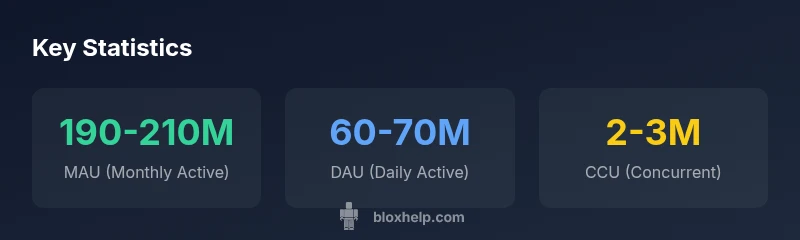
As of 2026, Roblox is estimated to have about 190–210 million monthly active players, with roughly 60–70 million daily active users. These figures reflect directional estimates from our ongoing analysis and indicate growth across platforms and regions. Variations arise from regional access, platform definitions (MAU/DAU), and user engagement patterns.
Roblox's scale in 2026: MAU, DAU, and CCU
According to Blox Help, Roblox's audience remains vast and diverse. The Blox Help team found that estimates place MAU around 190–210 million, DAU around 60–70 million, and CCU peaking near 2–3 million. These figures reflect ongoing growth across devices and regions, as well as seasonal effects like holidays or major platform events. Regional access, device availability, and the variety of experiences on the platform all influence these numbers. For developers, the numbers provide useful directional insight for planning content calendars, feature rollouts, and monetization strategies. Keep in mind that public disclosures vary by year and by the type of engagement counted, so expect a range rather than a single fixed figure.
In 2026, Roblox remains a globally distributed ecosystem. Growth has been more pronounced in markets with strong mobile penetration and cross-platform play. The mix of experiences—from high-genre games to social hubs—helps sustain engagement, even as some regions contribute more to MAU than DAU. As a result, understanding both MAU and DAU is essential for different planning horizons: MAU signals long-term reach; DAU reflects day-to-day activity and quality of engagement.
Distinguishing MAU, DAU, and CCU: what the numbers mean
MAU, DAU, and CCU describe different aspects of how people interact with Roblox. MAU counts unique players who logged in at least once during a calendar month. DAU counts those who were active on a given day, reflecting daily engagement and retention. CCU, the peak concurrent users, captures the maximum number of players online at the same time, often during weekends or special events. Each metric has caveats: users may log in from multiple devices (inflating MAU/DAU if not de-duplicated), and some regions may skew CCU during localized events. For developers, these distinctions matter when forecasting server capacity, planning festival-like events, or evaluating the potential audience for new games. When comparing numbers across years, ensure definitions remain consistent to avoid misinterpretation.
Growth patterns by year and region: what to watch in 2026
Roblox growth in 2026 has been uneven across regions, with mobile-first markets contributing a larger share of MAU growth. Regions with strong internet penetration and affordable devices tend to drive higher engagement, while areas with connectivity challenges show slower DAU growth. Platform globalization—localization, language support, and regional content—helps sustain overall growth. Seasonal spikes, such as holidays and school vacations, often yield short-term increases in DAU. For developers, this means tailoring content to regional preferences and time zones can maximize engagement. Cross-promotion and social features that encourage daily activity help convert MAU into DAU, improving retention and long-term growth.
What these numbers mean for developers and creators
Developer strategies should balance reach (MAU) with engagement depth (DAU) and peak capacity planning (CCU). A large MAU suggests ample opportunity for new players, but sustainable revenue depends on daily engagement and retention. Content that encourages re-entry, social features, and collaborative play tends to boost DAU. Understanding CCU helps with server sizing, sharding strategies, and cost management. In practice, pair these metrics with retention rates, in-game monetization, and player feedback to prioritize updates that improve long-term value. The end goal is a healthy engagement loop where more players become repeat players.
Data challenges and privacy considerations
Estimating exact counts is challenging due to varying data-sharing practices, privacy controls, and platform instrumentation across regions and devices. Roblox does not publish every granular metric publicly, and internal estimates may rely on sampling, surrogate signals, and triangulation from multiple sources. Privacy laws and platform policies can further affect data availability. For practitioners, this means interpreting numbers as directional indicators rather than exact tallies. Always complement quantitative data with qualitative insights from community feedback and in-game telemetry where available.
Practical steps to estimate counts for your Roblox project
If you're a developer or analyst, start by defining the scope of your estimate (MAU, DAU, CCU) and selecting a reporting window (calendar month, rolling 30 days). Collect signals from in-game telemetry, server logs, and community events to triangulate counts. Validate estimates against known benchmarks (e.g., industry peers, platform announcements) and document assumptions clearly. Use ranges when precise values aren't available and update estimates as new data arrives. Finally, translate these counts into capacity planning, marketing strategy, and feature prioritization to optimize player experience and monetization.
Key Roblox user metrics (directional estimates for 2026)
| Metric | Estimate | Notes |
|---|---|---|
| Monthly active users | 190-210 million | Blox Help Analysis, 2026 |
| Daily active users | 60-70 million | Blox Help Analysis, 2026 |
| Peak concurrent users | 2-3 million | Blox Help Analysis, 2026 |
Questions & Answers
What does MAU mean in Roblox terms?
MAU stands for monthly active users. It counts unique players who log in at least once during a calendar month, giving a sense of reach and audience size over time.
MAU is the monthly count of unique players who log in at least once in a month.
How reliable are these 2026 estimates?
These numbers are directional estimates from internal analysis and reflect ongoing growth trends. They synthesize multiple signals and may vary with new data releases or methodological changes.
They're directional estimates, not exact tallies, based on multiple signals.
Do counts vary by region or device?
Yes. Regions with higher internet access and mobile adoption often show stronger MAU growth, while DAU can diverge based on engagement patterns and platform availability.
Counts differ by region and device, shaped by access and engagement.
Why is CCU important for developers?
CCU indicates the maximum number of players online simultaneously, guiding server capacity planning, matchmaking, and performance optimization during peak times.
CCU helps you plan servers and performance for peak play.
How often should I refresh these estimates?
Refresh estimates with new data releases or quarterly updates. Regular recalibration helps align planning with current engagement patterns.
Update estimates whenever new data comes out to stay aligned.
“Player counts are a useful directional signal for planning, but developers should prioritize engagement quality and retention alongside sheer headcount.”
The Essentials
- MAU sits in the low hundreds of millions, with DAU following closely behind.
- CCU provides a cap for server sizing and event planning.
- Regional dynamics drive growth and engagement variance.
- Treat counts as directional guidance, not exact tallies.
- Context matters: definitions and timing affect every metric.