How big is Roblox compared to other games in 2026
Explore Roblox's size relative to peers in 2026—coverage of user base, engagement, platform reach, and monetization. Learn how to interpret game size for developers and players.


How big is Roblox compared to other games? In 2026, Roblox stands out for its vast ecosystem, driven by a huge, diverse community and cross‑platform reach. While some high‑revenue titles boast larger per‑player spend, Roblox’s overall footprint is amplified by user‑generated content, frequent events, and a low friction onboarding process that invites continuous participation across devices. This makes Roblox one of the most expansive game ecosystems in the market, especially for developers and players seeking breadth and experimentation.
What size means in the gaming world
In gaming, “size” is a multi‑faceted measure. It includes the scale of the active community, the breadth of platforms supported, the variety of content, and the robustness of the in‑game economy. For Roblox, size is not just about raw headcount; it’s about the breadth of experiences the platform enables, the speed at which new content can appear, and the diversity of creators who sustain an ongoing rhythm of releases. This nuanced view helps players and developers compare Roblox to other games without relying on a single statistic.
Roblox’s footprint in 2026: a qualitative snapshot
Roblox continues to leverage its unique position as a user‑generated content platform with cross‑platform access. The size it projects comes from a large, active creator community and a continuous stream of new experiences that keep players returning. The Blox Help team notes that Roblox’s growth is tightly linked to its ability to onboard new users quickly, lower barriers for creators, and support a broad spectrum of genres—from role‑playing to simulators and mini‑games. The scale is especially evident when considering global reach and the speed with which new games can appear in the ecosystem.
Roblox vs Minecraft: where the size matters
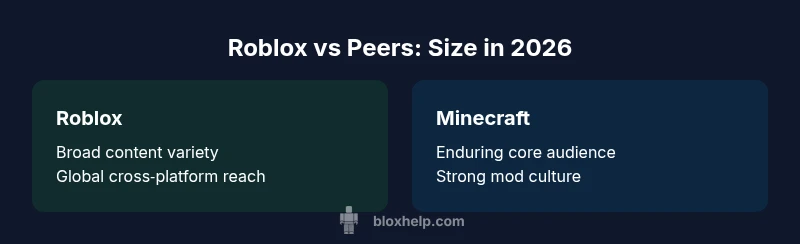
Minecraft remains a colossal force with a long‑running, dedicated fanbase and strong community mods. Roblox, by contrast, emphasizes rapid content turnover and a continuous influx of new creators. Size for Roblox is often about the number of concurrent user‑generated experiences and the breadth of playstyles represented, while Minecraft’s size is more about the persistence of core gameplay and the longevity of beloved titles. For developers evaluating platforms, Roblox’s size offers a dynamic testing ground for ideas, while Minecraft provides a stable, enduring audience of builders and explorers.
Participation vs revenue: what the numbers really tell you
Engagement metrics matter as much as revenue metrics when sizing a game’s impact. Roblox’s ecosystem thrives on daily participation and craftable content that doesn’t rely on premium downloads alone. This means a high ceiling for ongoing activity and discovery, even if per‑player spending varies widely across experiences. The key takeaway is that Roblox’s size translates into frequent touchpoints: new games appear often, players try multiple experiences, and creators iterate rapidly in response to feedback.
Platform breadth and access across devices
Roblox’s size is amplified by its cross‑platform availability. Players can jump between PC, mobile, and console interfaces, which broadens the potential audience and reduces friction for new players. Each platform contributes to the overall footprint by enabling different play patterns and monetization opportunities. The breadth of access also supports creators who tailor experiences for specific devices, further enriching the ecosystem and extending its reach beyond any single platform.
Content creation as a force multiplier
A central reason Roblox feels larger than many peers is the ecosystem of user‑generated content. Creators can publish quickly, monetize through virtual items, and build communities around their experiences. This dynamic multiplies the platform’s size without requiring a single, massive development studio. For players, it means a near‑endless stream of fresh experiences; for developers, it means rapid experimentation and feedback loops that can inform future projects.
Regional dynamics and global reach
Roblox shows varying degrees of popularity across regions. In some markets, it acts as a gateway to digital play, while in others it competes with locally dominant titles. Size in regional terms is often about the density of creators, the availability of local language support, and regional events or partnerships. A truly global footprint emerges when cross‑region collaboration, translation, and localized experiences sustain ongoing activity.
Growth drivers and eventual weathering factors
Roblox has benefited from a steady stream of events, collaborations, and influencer participation that keep the platform relevant. However, growth can slow if onboarding becomes cumbersome, creator incentives shift, or competition from other live‑service titles intensifies. The health of Roblox’s size depends on maintaining a welcoming creator environment, ensuring fair monetization, and investing in developer tools that reduce friction for new creators.
Limitations and caveats when comparing size
Comparing size across titles requires careful framing. Roblox’s strength lies in breadth and variety, not in the dominant share of revenue per user. Some peers may offer higher ARPU (average revenue per user) or more consolidated content libraries, which can skew perceptions of size when only one metric is considered. It’s essential to use a balanced set of indicators—audience breadth, engagement depth, platform reach, and content velocity—to form a complete view.
How to interpret Roblox’s size for your project
If you’re deciding where to publish or invest development effort, consider what you want to maximize. Roblox’s size provides a vast testing ground and immediate access to a broad audience, but it also demands attention to community standards, content moderation, and creator incentives. For creators exploring ideas with rapid iteration, Roblox offers a fertile landscape; for large, single‑franchise experiences, alternative platforms might offer distinct advantages.
Implications for developers considering Roblox as a publishing choice
For developers, Roblox offers the potential for rapid prototyping, community engagement, and low upfront costs. The platform’s size can accelerate discovery through viral loops and a steady stream of user‑generated content. However, it requires ongoing engagement with the creator ecosystem, careful consideration of monetization models, and a plan for long‑term content support. A thoughtful approach to tooling, localization, and player feedback is essential to leverage Roblox’s size effectively.
Practical takeaways for players and creators
Players should expect a constantly evolving library of experiences and frequent new ideas to explore. Creators can capitalize on Roblox’s size by focusing on accessible entry points, clear monetization paths, and community building. Broader reach across devices means opportunities to learn, iterate, and scale ideas with real feedback. For both audiences, staying engaged with official channels and creator forums helps maximize what Roblox’s size can offer.
What trends are likely to shape Roblox’s size going forward
Future shifts will hinge on improvements to creator tools, expansion into new regions, and partnerships that broaden the available experience spectrum. Advances in accessibility, moderation, and cross‑platform play can further amplify size by lowering friction for new players and lowering barriers for new creators. The trajectory will depend on balancing growth with sustainable creator incentives and community health.
Feature Comparison
| Feature | Roblox | Minecraft | Fortnite | Grand Theft Auto V (GTA V) |
|---|---|---|---|---|
| Active participation (qualitative) | Very broad and diverse participation across many experiences | Strong, persistent engagement with user‑made worlds | High engagement with live events and updates | Large, dedicated audience for a single, cohesive game world |
| Platform breadth | Cross‑platform: PC, mobile, and consoles | Primarily PC/mobile with strong console presence | Cross‑platform across multiple devices and regions | Primarily console and PC with established online ecosystem |
| Content creation model | User‑generated content with rapid iteration | Player‑made content and mods with long history | Developer‑driven content with frequent events | Designer‑driven, single‑title experience |
| Monetization approach | Creator monetization and virtual economy | Direct purchase of a single game plus mods | In‑game purchases tied to live updates | Premium price with downloadable content |
| Growth stability | Dynamic growth fueled by new creators and experiences | Steady, long‑term growth with a loyal audience | Surges during events and collaborations | Mature, steady revenue stream from core game |
Benefits
- Massive ecosystem with rapid content turnover
- Low barrier to entry for new creators
- Cross‑platform accessibility expands reach
- Vibrant creator economy fosters experimentation
- Large discovery potential for players
What's Bad
- Per‑experience monetization can be uneven
- Quality and safety vary across user‑made content
- Onboarding and moderation are ongoing needs
- ARPU may be lower on average than premium titles
Roblox wins on breadth and ecosystem vitality; best for exploration and rapid experimentation, with solid reach across devices
Choose Roblox if you value a vast, dynamic content library and broad audience access. If your goal is a tightly focused, high‑ARPU title, consider alternatives with more centralized content and monetization.
Questions & Answers
How does Roblox's size compare to Minecraft's size in 2026?
Both games are large in their own ways. Roblox emphasizes a broad, rapidly evolving ecosystem with many experiences, while Minecraft sustains a long‑running core audience with enduring, creative builds. Size comparisons should weigh breadth and content velocity for Roblox against enduring engagement and mod culture for Minecraft.
Roblox is bigger in breadth and content turnover, while Minecraft has a more stable, long‑lasting audience and community.
What metrics matter most when sizing a game like Roblox?
Important metrics include platform reach, content velocity, player engagement across experiences, and the health of the creator economy. Unlike single‑title games, Roblox’s size is driven by the diversity of experiences and the rate of new content.
Focus on reach, engagement across experiences, and the health of the creator economy to gauge size.
Is Roblox bigger than highly monetized titles per user?
Roblox generally does not rely on very high per‑user spend; its strength is aggregate ecosystem activity and cross‑experience engagement. Some top titles may monetize more per user, but Roblox’s footprint comes from many small purchases across a wide base.
Roblox’s size comes from many users and experiences, not high spend per user.
How important are platforms to Roblox's size?
Platform breadth matters a lot. Roblox’s cross‑platform availability lets players switch devices easily, broadening the audience and sustaining activity across the ecosystem.
Cross‑platform access keeps the ecosystem lively and broad.
What should developers consider before publishing on Roblox?
Consider the rapid content cycle, the creator ecosystem, and monetization paths. Roblox offers speed and reach, but success depends on engagement, feedback loops, and tools that support ongoing content updates.
Roblox can accelerate growth if you plan for ongoing content and community engagement.
The Essentials
- Assess size across engagement, reach, and content variety
- Roblox excels in ecosystem breadth, not per‑player revenue
- Cross‑platform access amplifies Roblox’s footprint
- Consider your goals: experimentation vs. premium, single‑title experiences
- Monitor creator incentives and moderation for sustainable growth