Is Roblox Better Than Minecraft? An In-Depth Comparison
An objective side-by-side comparison of Roblox and Minecraft, focusing on gameplay, creation tools, communities, platforms, and monetization to help players decide which fits their goals.


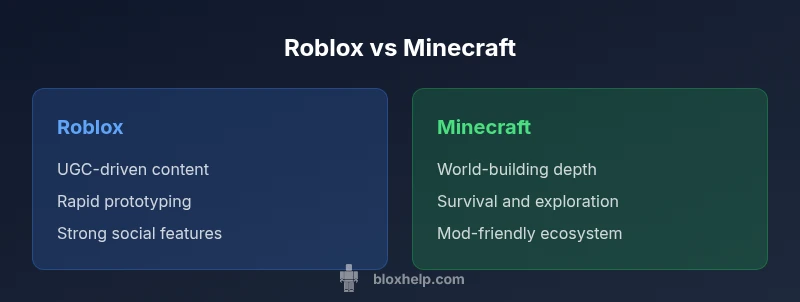
Is Roblox better than Minecraft? The short answer is: it depends on your goals. Roblox excels at rapid game creation, social play, and user-generated content, while Minecraft shines in core survival gameplay, creative building, and a consistent feature set. For beginners looking to prototype concepts quickly, Roblox often wins; for players seeking deep world-building and mod-friendly depth, Minecraft holds the edge. The best choice hinges on what you value most.
Defining the question: is Roblox better than Minecraft?
When you compare Roblox and Minecraft, the question isn't a simple yes or no. The phrase is Roblox better than Minecraft invites a discussion about goals, audience, and play style. In practical terms, what counts as “better” varies with whether you want to prototype games quickly, connect with friends, learn basic game design, or build expansive worlds over months or years. The search for an objective verdict should start with clear criteria: creativity, accessibility, platform reach, monetization, and learning value. According to Blox Help, framing the comparison around these pillars helps avoid the trap of assuming one title is universally superior. For many players, the best answer to is Roblox better than Minecraft is: it depends on your priorities and your willingness to invest time learning a given toolset. In this article we’ll unpack the core differences, common use cases, and practical decision rules to help you choose wisely.
Core gameplay and design philosophies
Roblox operates as a platform hosting thousands of user-created experiences, each built with Roblox Studio. Its core design philosophy emphasizes accessibility, rapid iteration, and social discovery. Experiences range from obstacle courses to complex simulations, and many developers reuse core mechanics to spawn new playstyles. Minecraft, by contrast, anchors its identity in a consistent sandbox loop: gather resources, craft, build, and survive within a world governed by simple rules. This yields deep, enduring play patterns that reward long-term planning and experimentation. The takeaway is to evaluate core gameplay focus: Roblox prioritizes breadth and community-driven variety; Minecraft emphasizes depth, consistency, and durable world-building across many play sessions.
Creation tools and modding culture
Creation in Roblox happens through Roblox Studio, a relatively accessible, code-friendly environment that encourages rapid experimentation and sharing. Developers publish experiences that others can visit, remix, or extend, fostering a culture of collaborative creation. Minecraft supports extensive modding and datapack ecosystems that alter mechanics, add content, and redefine progression. While Roblox content scales through user-generated experiences and in-game economies, Minecraft content often expands via third-party tools, mods, and community packs. If you value a plug-and-play production cycle with built-in social features, Roblox shines; if you prize modular customization and deep game-altering possibilities, Minecraft’s modding culture is a strong draw.
Community, social features, and multiplayer experience
Roblox emphasizes social interaction and discovery. Players often connect through experiences, friends lists, and in-game chat, with a strong emphasis on sharing and collaborating on projects. The social ecosystem grows as creators publish new experiences that invite participation and collaboration. Minecraft’s community centers on companionship, cooperation, and survival teamwork, with a long-standing tradition of public servers, vanilla worlds, and redstone-enabled collaborations. Both platforms offer multiplayer experiences, but Roblox tends to favor quick, social, short-form sessions, while Minecraft supports longer, cooperative builds and persistent worlds that can evolve over years.
Accessibility, platforms, and onboarding
Roblox is designed for broad accessibility across devices—PC, console, and mobile—often with cross-platform play. New users can jump into a curated catalog of experiences without a steep initial learning curve, making it appealing for younger audiences or players who want to start creating quickly. Minecraft also supports cross-platform play, but the onboarding experience varies by edition. The Java Edition offers powerful modding and customization for seasoned players, while the Bedrock Edition emphasizes stability and consistency across devices. In short, Roblox excels at quick entry and social discovery; Minecraft offers a broader spectrum of playstyles with more stubborn learning curves for builders and modders.
Content lifecycle and longevity
Roblox experiences tend to rise and fall with creator activity and seasonal trends. A popular experience can attract millions of visits in a short window, then taper off as new games emerge. Minecraft worlds and servers can persist for years, especially on long-term servers or modded environments with dedicated communities. The longevity of feedback loops matters: Roblox rewards rapid iteration and fresh content, while Minecraft rewards continuity, large-scale projects, and persistent servers. For someone prioritizing ongoing world-building and a legacy of user-generated mods, Minecraft often provides durable engagement; for those chasing new, social, bite-sized experiences, Roblox’s content cadence is more appealing.
Monetization, economy, and value
Roblox implements an in-game economy centered on Robux, powering creator earnings, game features, and purchasables. Developers can monetize experiences through in-game items and access, influencing the incentives to publish and iterate. Minecraft’s monetization is more fragmented: a mix of game purchases (where applicable), DLCs, and the Minecraft Marketplace for Bedrock content. The economics in Roblox emphasize ongoing creator revenue and a marketplace-driven ecosystem, while Minecraft emphasizes a one-time purchase model with optional add-ons or DLCs depending on edition. Understanding your expected revenue model can shape how you invest time in each platform.
Performance, reliability, and technical constraints
Performance varies by device and game design. Roblox experiences must run smoothly on a wide range of hardware and can vary in optimization across titles, which makes testing important. Minecraft’s performance is generally consistent within each edition, but mods and resource packs can introduce variability. The technical constraints of Roblox—such as physics, scripting limits, and asset loading—shape what kinds of experiences are practical. Minecraft’s block-based world can support enormous builds, but large mods can strain performance on lower-end devices. When choosing, consider your target audience's hardware and the type of experiences you plan to publish or join.
Educational and family-friendly considerations
Both platforms offer educational potential and family-friendly content, though in different forms. Roblox can be a gateway to game design and scripting concepts for younger creators, with an emphasis on collaborative projects. Minecraft has a long-standing record of classroom use, with structured lessons around creativity, resource management, and problem-solving. Schools integrating Minecraft often highlight hands-on learning and experimentation, while Roblox education initiatives focus on introductory programming and project-based learning. For families weighing safety and suitability, both platforms provide parental controls and moderation, but the scope and implementation differ.
Practical guidance for creators and players
If you’re deciding where to start, outline your goals first: do you want to learn basic game design, socialize, and publish quickly, or do you aim for deep worlds, mods, and long-term projects? For rapid prototyping and social discovery, Roblox is a strong starting point; for depth, tradition, and mod-friendly experimentation, Minecraft is a compelling choice. Build a small project on Roblox Studio to learn scripting fundamentals, then explore a Minecraft mod or datapack to understand how deeper mechanics are implemented. Finally, join communities on both platforms to observe best practices, gather feedback, and iteratively improve your creations.
Decision framework: how to choose between Roblox and Minecraft
A practical decision framework begins with your goals: if you want speed, social play, and monetization potential, choose Roblox. If you want consistent core gameplay, deep world-building, and modding flexibility, choose Minecraft. Consider your target audience, device availability, and willingness to learn tool-specific workflows. Use a small, side-by-side test project on each platform to compare ease of use, creative control, and long-term viability. The framework here is pragmatic: map goals to features, test with a minimal viable project, and measure how well each platform aligns with your objectives.
Getting started today: steps to try both platforms
- Create a basic Roblox experience using Roblox Studio to learn scripting fundamentals.
- Build a simple Minecraft world in Creative mode to explore building mechanics and world shaping.
- Join community forums, watch beginner tutorials, and participate in starter events on both platforms.
- Track your engagement, time-to-publish, and your satisfaction with the creative process to determine which environment better supports your goals.
- Revisit your initial criteria after 2–4 weeks and decide which platform to invest deeper in.
Comparison
| Feature | Roblox | Minecraft |
|---|---|---|
| Core gameplay focus | UGC-driven experiences and social play | Sandbox survival and creative building |
| Creation tools | Roblox Studio for rapid, shareable experiences | Minecraft vanilla + mods/datapacks for deep customization |
| Platform reach | Cross-platform access on PC, consoles, and mobile | Cross-platform on Bedrock, with Java edition on PC |
| Monetization model | In-game economy via Robux and creator earnings | One-time purchase with optional DLCs and marketplace content |
| Modding/Content creation | Built-in content creation with distribution in-platform | Extensive modding via community tools and datapacks |
| Audience and use-case | Broad, younger-skewed audience; quick-to-publish experiences | Older-skewed audience; long-term world-building and mods |
Benefits
- Encourages rapid prototyping and community collaboration
- Strong social features and built-in distribution networks
- Low barrier to entry for creators and players
What's Bad
- Roblox monetization can drive ongoing content creation pressure
- Content quality varies across experiences
- Minecraft modding can be technically complex and fragmented
Roblox is the better pick for quick creation and social play; Minecraft wins for depth and long-term world-building
If your priority is rapid development and social engagement, Roblox leads. If you value deep construction, survival mechanics, and modding potential, Minecraft remains superior. Use this guidance to align your choice with your goals.
Questions & Answers
Is Roblox better for beginners than Minecraft?
For beginners, Roblox often has a gentler entry point due to Roblox Studio’s guided workflows and a large library of starter experiences. You can publish and iterate quickly, learning scripting concepts along the way. Minecraft, while also accessible, typically requires more upfront commitment for modding and world-building.
Roblox is generally easier to pick up for beginners because you can start building quickly with guided tools, while Minecraft’s depth may require more time to learn its systems.
Can you mod Roblox or Minecraft?
Minecraft supports extensive modding and datapacks that modify gameplay and add new content. Roblox does not support external mods; instead, creators build experiences within Roblox Studio and publish them to the Roblox platform.
Minecraft supports mods; Roblox uses in-platform experiences built with Roblox Studio.
Which has better cross-platform support?
Both aim for broad reach. Roblox emphasizes cross-platform access across PC, consoles, and mobile, while Minecraft’s Bedrock edition reinforces cross-platform play, with Java Edition offering different capabilities on PC.
Both support cross-platform play, though the ecosystems and editions differ in how features are implemented.
Are Roblox games suitable for kids?
Roblox hosts a wide range of experiences, including many kid-friendly options, but the platform’s open-ended nature means parental oversight is important. Minecraft is also family-friendly, with content tailored by edition and server rules.
Both platforms can be kid-friendly, but parental oversight matters on Roblox due to the wide range of experiences.
Is Minecraft Education Edition a factor in deciding?
Minecraft Education Edition offers classroom-oriented features and lesson plans, which can be a deciding factor for educators. Roblox has educational potential too, but its strongest case is in game development literacy and creative coding.
Education Edition is a factor for Minecraft in classrooms; Roblox supports coding through a broader creator ecosystem.
Which platform is more monetizable for creators?
Roblox centers monetization around the creator economy with Robux purchases and in-game economics. Minecraft’s monetization is more limited and edition-dependent, typically tied to game purchases and marketplace content.
Roblox often provides more direct monetization through creator earnings, while Minecraft is more edition-based.
The Essentials
- Define your goal before choosing: creation speed vs world depth
- Roblox excels in UGC and social experiences; Minecraft excels in depth and modding
- Platform reach and monetization shape the decision
- Experiment with beginner projects on both to inform your choice