Roblox vs Fortnite: A Practical Comparison
An analytical side-by-side comparison of Roblox and Fortnite, exploring ecosystems, monetization, accessibility, and community to help players and developers decide where to invest time and creativity.


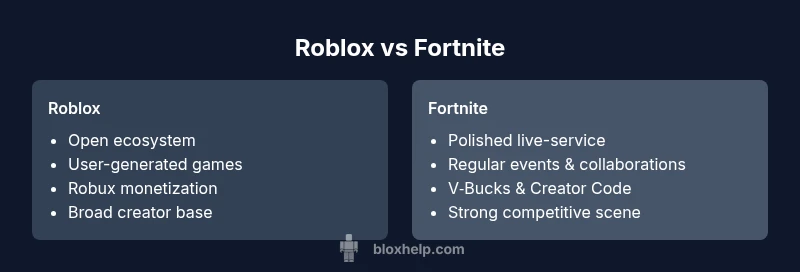
Roblox vs Fortnite is less a battle of games and more a study in ecosystems. Roblox centers on user-generated experiences, Lua scripting, and creator monetization through Robux, while Fortnite offers polished live-service gameplay, cross‑platform play, and frequent collaborations. For builders and long-term creators, Roblox provides broad opportunities; for players seeking high production value and constant events, Fortnite stands out.
Setting the stage: Roblox vs Fortnite in 2026
The debate between Roblox and Fortnite has evolved beyond simple preference into a study of ecosystems, economies, and learning curves. Roblox remains a platform built around user-generated content where creators design experiences, publish them to the catalog, and earn revenue through in-game economies. Fortnite, by contrast, operates as a curated, live-service title with frequent collaborations, seasonal events, and tightly controlled content pipelines. For players who crave self-expression and for developers who want to prototype ideas quickly, the choice between roblox vs fortnite shapes not just what you play, but how you build and monetize your skills. According to Blox Help, the Roblox model tends to reward long-term engagement with a wider range of entry points for creators, from simple experiences to intricate simulations. The Blox Help team highlights that this openness lowers the entry barrier for beginners, but also places more responsibility on creators to maintain quality and safety. Meanwhile, Fortnite’s ecosystem prioritizes high-fidelity production, cross-platform play, and rapid discovery through events; it is optimized for short-term, high-impact experiences.
Core ecosystems: user-generated content vs curated experiences
At the heart of roblox vs fortnite lies a fundamental difference in purpose. Roblox is a sandbox of potential: creators design games, worlds, and simulations using Roblox Studio, and players explore, remix, and monetize their ideas in an open catalog. The emphasis is on scaling creativity, with a broad variety of genres—from obbys to social hubs—driven by a global creator economy. Fortnite, however, is a curated platform where Epic Games steers most experiences, ensuring a consistent level of polish, accessibility, and cross‑promotion. The contrast matters for developers: Roblox rewards ongoing iteration and community input, while Fortnite rewards scouted partnerships, limited-time modes, and cross‑franchise collaborations. This structural split shapes everything from discovery pipelines to revenue potential and community expectations.
Audience, monetization, and player engagement
Roblox tends to attract a wider age spectrum, with a learning curve that introduces aspiring developers to game logic, UI design, and social features through approachable tools. The monetization path is rooted in Robux and DevEx, offering revenue sharing for creators who publish compelling titles. Fortnite targets players who crave high‑fidelity visuals, competitive play, and social experiences anchored by live events. Its monetization relies on V‑Bucks and Creator Codes, with revenue tied to in-game purchases, cosmetics, and sponsorships. Engagement patterns diverge as a result: Roblox enables longer-term exploration of many tiny experiences, while Fortnite leans toward short spikes of intensified play and community-driven events that keep participants returning.
Creation tools and accessibility
Roblox Studio, paired with Lua scripting, enables a vast range of user-generated content, from simple obstacle courses to complex simulations. The learning curve is gentle for beginners who persist with tutorials, sample projects, and a thriving community. Fortnite Creative, built on the Unreal ecosystem, offers powerful tooling but with a steeper onboarding curve for creators who want to push into advanced scripting or large-scale maps. Accessibility matters: Roblox’s lower entry threshold and open catalog can democratize creation, yet maintaining quality requires discipline and ongoing support for safety and quality control. Fortnite’s tooling rewards technical proficiency and professional workflows, which can limit participation to more dedicated creators.
Content moderation, safety, and community guidelines
Both platforms enforce rules to protect players, but they take different approaches. Roblox relies on community reporting, automated checks, and a catalog review system for new games, which can result in uneven quality but broad inclusion. Safety features, parental controls, and age-appropriate defaults are essential for younger users navigating a large catalog. Fortnite emphasizes stricter brand alignment and content standards due to high-profile collaborations and IP partnerships, which can streamline moderation but narrow the creative leeway for some creators. For families, understanding moderation dynamics helps set expectations about what kinds of experiences are likely to appear and how to report concerns effectively.
Content variety and longevity
Roblox excels in variety because hundreds of thousands of creators continuously publish new experiences; discovery remains a perpetual challenge, but the sheer breadth can deliver enduring playgrounds for exploration. Fortnite’s longevity rests on its live events, seasonal chapters, and crossovers that refresh the game world regularly, creating buzz and attracting media attention. This balance means Roblox experiences may outlive individual games if creators continue to update them, while Fortnite depends on ongoing production cycles and seasonal events to sustain momentum. The result is a mixed ecosystem: endless micro‑experiences on Roblox and a curated, high‑octane schedule on Fortnite.
Cross-platform play and technical considerations
Both titles aim for broad device support, yet their cross‑platform strategies differ. Roblox runs on PC, mobile, and consoles, prioritizing accessible controls and social play, while Fortnite has long championed cross‑play across major platforms, with synchronized updates and competitive integrity. Technical considerations for creators include input handling, performance optimization, and asset pipeline compatibility. Roblox Studio projects are typically more modest in scope, with lower polygon budgets, whereas Fortnite projects often push for photorealistic visuals and networked multiplayer stability. If your goal is wide reach with easy entry, Roblox offers momentum; if your aim is reach coupled with highly polished experiences, Fortnite’s cross‑platform ecosystem provides a stronger stage.
Monetization economics for creators
Roblox monetization centers on Robux, in-game purchases, and the Developer Exchange program, enabling creators to convert virtual earnings into real currency. The success of a Roblox project often hinges on ongoing engagement, social growth, and in‑experience economies. Fortnite monetization is anchored by cosmetic sales, a Creator Code program, and collaborative IP partnerships, which can yield significant revenue for top creators and studios when aligned with cross‑promotional campaigns. The economics differ in cadence and risk: Roblox rewards steady, long‑tail growth through diverse experiences, while Fortnite rewards blockbuster collaborations and seasonal momentum that can deliver quick wins but require constant innovation.
Competitive and social features
Competition and social dynamics are central to both platforms, but they manifest differently. Roblox emphasizes social hubs, user-driven games, and multiplayer socialization within a vast catalog, encouraging long-term engagement in communities built around specific titles. Fortnite emphasizes competitive modes, tournaments, and live events that unify players around a shared, time-limited spectacle. The social lifecycle on Roblox can be more introverted to mid-scale communities; Fortnite’s social flow tends to be extroverted and event-driven, generating spikes in participation and media attention whenever an event drops.
Case studies: typical player journeys on Roblox vs Fortnite
Consider the Roblox creator who begins by building a simple obstacle course, learns Lua scripting, and gradually expands to a multifaceted game with monetization, community groups, and regular updates. This path prioritizes learning, iteration, and long-term growth. Contrast that with a Fortnite-focused creator who partners on a limited-time collaboration map, experiments with creative templates, and leverages Epic’s support for exposure through cross‑promotions. The first path emphasizes self-direction and sustainability; the second concentrates on rapid discovery, external partnerships, and high‑visibility events. Both trajectories can be successful, depending on the creator’s goals, resources, and risk tolerance.
How to decide: scenarios for players and developers
- If you love building, iterating, and growing a private community over years, Roblox is your playground. It rewards curiosity and persistence with a broad creative sandbox and monetization pathways.
- If you want exposure, high production value, and a direct path to large audiences through events and collaborations, Fortnite offers a higher ceiling for creator visibility but with greater onboarding requirements and ongoing production demands.
- For families seeking a safe, diverse set of experiences with moderated content, Roblox’s safety tools and parental controls can be a practical fit, while Fortnite’s curated IP and events provide a different kind of child-friendly spectacle.
Getting started: first steps for beginners in Roblox and Fortnite
Beginners curious about roblox vs fortnite should start with a clear goal. If your aim is to create, begin with Roblox Studio tutorials, complete beginner projects, and join creator communities to learn Lua basics. Practice publishing a simple game, study feedback, and iterate or add features gradually to avoid overwhelming complexity. If your aim is to contribute through creative maps in Fortnite, explore the Creative mode, study published islands, and participate in Epic’s creator networks or partnerships. In both paths, set measurable milestones, maintain safety practices, and allocate time for learning the tools and building a portfolio that demonstrates your progress.
Comparison
| Feature | Roblox | Fortnite |
|---|---|---|
| Core purpose | User-generated experiences and monetization via Robux | Polished live-service gameplay with ongoing events |
| Content creation tools | Roblox Studio with Lua scripting | Fortnite Creative / Unreal Editor for creators |
| Monetization model | Robux-based revenue; DevEx and in-game economies | V‑Bucks; Creator Codes; cosmetics and cross-promotions |
| Audience and accessibility | Broad age range; open catalog; variable quality | Teen-to-young-adult players; high polish; strong onboarding |
| Cross‑platform support | PC, mobile, consoles; social features | |
| Content moderation | Community-driven review; varying quality across titles | Curated standards with strong IP compliance |
Benefits
- Huge creative potential with user-generated content
- Broad, diverse player base across ages
- Flexible monetization and developer tools
- Low barrier to entry for starting projects
What's Bad
- Quality control can be uneven across user-generated games
- Revenue potential depends on platform policies and audience
- Steeper learning curve for Roblox Studio and scripting
- Fortnite's ecosystem is more controlled for creators
Roblox favors long-term creator-led engagement while Fortnite remains dominant for polished live-service experiences.
Choose Roblox if you want broad creative control and ongoing community-building opportunities. Choose Fortnite if you prioritize high production value, collaborations, and competitive play.
Questions & Answers
What is Roblox and how does it differ from Fortnite?
Roblox is a platform for user-generated games and experiences, with monetization tied to Robux and a creator ecosystem. Fortnite is a polished live-service shooter with frequent events and cross‑platform play. The core difference is open creativity versus curated, high-production content.
Roblox is about making games; Fortnite is about playing in a big, ongoing event-driven world.
Is Roblox free to play?
Yes, Roblox is free to play. Players can access many experiences without paying, though optional in-game purchases can enhance experiences and support creators. Remember to use safety settings for younger players.
Roblox is free to join and explore; you can buy virtual items if you want to support creators.
Can Roblox games earn real money?
Yes, creators can earn real money through the Roblox DevEx program and revenue from in-game items. Earnings depend on user engagement, Robux sales, and eligibility, with creators needing to meet platform requirements.
Yes, you can turn some Roblox experiences into real money if you meet the program rules.
Is Fortnite cross-platform with Roblox?
No, Roblox and Fortnite operate as separate ecosystems with different technical bases and accounts. They are not cross‑play compatible, and most players engage with one or the other based on preference.
They don’t cross-play; they’re separate games and ecosystems.
Which is easier for beginners to create in, Roblox or Fortnite?
Roblox generally offers a gentler entry for beginners with Roblox Studio and Lua, plus a wide range of tutorials. Fortnite Creator can be approachable but toward more advanced projects requires more time to learn the tools.
Roblox is usually easier to start with if you want to create your own games.
What safety tools exist for younger players?
Both platforms provide parental controls and safety settings. Roblox emphasizes age-appropriate filtering and reporting; Fortnite emphasizes content guidelines and moderation for cross-promotional content.
Both platforms have safety and parental controls to help keep kids safe.
The Essentials
- Choose Roblox for long-term creator-driven growth
- Fortnite excels at polished, event-driven experiences
- Monetization paths differ: Robux-based vs Creator Code/V-Bucks
- Safety and moderation shape what creators publish
- Cross-platform reach matters for audience growth
- Both platforms reward momentum and continuous learning