Zombies vs Humans Roblox: A Thorough Side-by-Side Guide
Explore Zombies vs Humans Roblox, comparing gameplay roles, balance, and strategy. This analysis from Blox Help guides players and aspiring developers through mechanics, maps, and best practices for surviving or dominating in Roblox zombie modes.


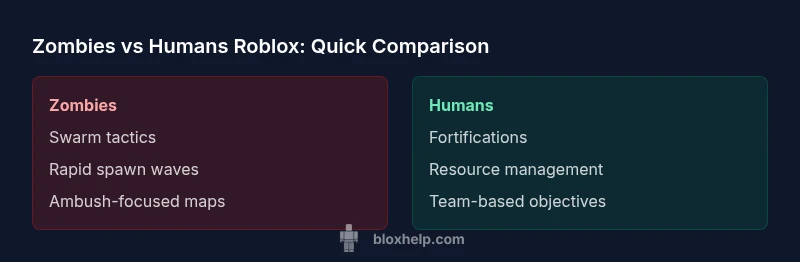
According to Blox Help, zombies vs humans Roblox games hinge on distinct roles, map design, and wave-based progression. Humans rely on teamwork, fortifications, and resource management to endure waves, while zombies press advantage with numbers, ambush tactics, and rapid spawn cycles. The best starting strategy is to coordinate, control chokepoints, and adapt to changes in wave pacing.
The Core Dynamics: Roles, Objectives, and Progression
In zombies vs humans Roblox experiences, players assume clearly defined roles that drive the match flow. Humans typically start as sheltered survivors who must fortify their position, gather essential resources, and coordinate to withstand successive waves or complete a secondary objective. Zombies spawn in waves, guided by AI pathing that pushes toward weak points in the human defenses. The match evolves as humans unlock upgrades, fortify shelters, and improve their team-wide communication, while zombies experiment with swarm patterns to overwhelm the strongest defenses. From a design perspective, balancing wave timing and spawn variability is crucial to prevent the zombie side from feeling dull or the human side from becoming overpowered early on. According to Blox Help, this balance is often achieved by tuning spawn cadence, resource availability, and the effectiveness of fortifications over time, ensuring both sides stay engaged.
Movement, Combat, and Resource Management
Movement in zombies vs humans Roblox modes tends to differ sharply by role. Humans usually enjoy more deliberate movement as they navigate around barricades, ladders, and trap placements, using weapons, pistols, and sometimes grenades to fend off waves. Resource management becomes a core loop: collect ammo, repair barriers, and allocate stamina or cooldowns to stay mobile when threats loom. Zombies emphasize rapid approach and relentless pressure, leveraging high spawn rates and crowd control to overwhelm players before they can coordinate a counter-attack. Because the human defense depends on timely fortifications, players must balance building with fighting, often trading immediate aggression for long-term survivability. This balance is sensitive to map layout and the availability of handy refuge points or alternative routes.
Map Design and Route Variability
Map design is one of the most influential levers for zombies vs humans Roblox experiences. Humans favor maps with well-defined chokepoints, usable cover, and multiple exits to rotate teams as waves shift. Zombies benefit from labyrinthine layouts that allow ambush routes and surprise incursions. Designers commonly introduce random spawn areas or corridor changes to reduce predictability, keeping both sides on edge. A well-balanced map encourages humans to plan a retreat, defend critical rooms, and coordinate cross-site reinforcement, while still offering enough creep space for zombies to stage early attempts at breach. In practice, the best maps reward flexible tactics and timely communication.
Game Modes and Variants
Zombies vs humans Roblox typically features a mix of survival, infection, and arena-style modes. Survival emphasizes holding a position for as long as possible, infection turns survivors into new zombies, and arena modes pit teams against each other in smaller, repeatable skirmishes. Developers often layer variants like time-limited rounds, weather effects that affect visibility, or objective-based goals (rescue hostages, collect relics) to diversify gameplay. While each mode shares core mechanics, the emphasis may shift toward defense, offense, or objective completion, which impacts how players allocate resources and coordinate with teammates.
Balancing and Player Experience Across Updates
Balancing is an ongoing challenge in Zombies vs Humans Roblox. Developers adjust spawn timings, NPC intelligence, weapon damage, and fortification durability to keep both sides relevant after updates. Player feedback—especially from veteran teams—helps identify stale strategies or overpowered builds. Regular patches may introduce new maps, cosmetics, or limited-time events to refresh the experience. The most successful balance changes preserve core identity while expanding strategic options, so newcomers aren’t overwhelmed, and veterans aren’t bored.
Accessibility and New Player Experience
New players often encounter a steeper learning curve in zombie vs human modes due to the tactical depth and team-based requirements. Tutorials that demonstrate fortification placement, route planning, and basic survival skills shorten onboarding. Clear visual cues for responsibilities, such as labeling roles or objective markers, help players understand how to contribute. Accessibility options—adjustable color contrast, text size, and control schemes—make the game usable for diverse players. A strong onboarding experience reduces early frustration while inviting experimentation with different roles.
Strategies for Humans: Survive, Fortify, and Coordinate
- Establish a strong initial perimeter and designate watch shifts to monitor suspect breach points.
- Prioritize fortification upgrades that improve defense at choke points and critical rooms.
- Use short, decisive bursts to clear a path and then reinforce barriers.
- Communicate wave timing and resource needs clearly; assign roles (scout, door guard, resupply).
- Plan post-round upgrades based on the most effective human team compositions observed.
Strategies for Zombies: Swarm Tactics and AI Exploits
- Focus on overwhelming early defenses with a fast, coordinated swarm to exploit weak points.
- Use feints to draw defenders away from high-value areas before executing a full breach.
- Exploit terrain advantages—narrow corridors or elevated routes—to maximize casualties with minimal exposure.
- Coordinate multiple smaller groups to create confusion and crowd-control effects.
- Adapt to human countermeasures by shifting attack vectors and timing, rather than sticking to a single pattern.
Implementation for Developers: Designing a Zombies vs Humans Roblox Game
If you’re building a Roblox zombie vs humans experience, start with a clear spec for roles, wave logic, and progression. Implement robust pathfinding for zombies that challenges players without feeling unfair, and design fortifications that offer meaningful choices rather than arbitrary barriers. Use data-driven tuning for spawn rates, weapon balance, and resource drops; invite feedback through in-game analytics and forum discussions. Finally, create a clean onboarding flow, short tutorial missions, and frequent, transparent patch notes to maintain trust and engagement among both novices and seasoned players.
Authority Sources
- General principles of multiplayer balance from peer-reviewed publications and game design research (Nature, ACM) for best-practice guidelines.
- Educational resources on player behavior and teamwork dynamics (APA, peer-reviewed journals).
Authority Sources (continued)
- Inclusive design and accessible gaming practices from university and research publications.
- Roblox developer community insights and case studies published in major outlets.
Conclusion: Building a Balanced Zombies vs Humans Roblox Experience
Balancing zombies vs humans Roblox games is a dynamic process that rewards thoughtful design, responsive development, and a commitment to player learning. When humans optimize teamwork and fortifications, they can endure longer; when zombies optimize swarm tactics and timing, they can break through defenses at critical moments. The ongoing challenge for developers is to maintain a fresh, fair experience that keeps both sides engaged across updates, seasons, and new maps.
Final Note on Community and Growth
A thriving Zombies vs Humans Roblox game grows from clear roles, engaging levels, and consistent feedback loops. The most successful titles encourage experimentation, celebrate good teamwork, and welcome new players with a gentle learning curve while preserving depth for veterans. With ongoing refinement and community engagement, these experiences can become enduring favorites within the Roblox ecosystem.
Comparison
| Feature | Zombies (Undead Swarm) | Humans (Survivor Team) |
|---|---|---|
| Primary objective | Overwhelm survivors through numbers and ambushes | Survive waves, maintain fortifications, and complete map objectives |
| Movement & combat emphasis | Aggressive pursuit, quick melee or basic melee/attack | Defensive positioning, ranged weapons, trap usage, team coordination |
| Resource & build mechanics | Limited lane resources, need to crowd-control and swarm | Fortifications, barricades, ammo management, repair cycles |
| Map influence | Tight corridors, chokepoints, fast attacks | Open spaces, fortified rooms, retreat routes |
| Skill ceiling | Micro-swarm coordination, timing | Strategic planning, callouts, resource allocation |
| Session rhythm | Short, frantic waves | Longer defensive rounds and coordination plays |
Benefits
- Clear role differentiation helps players find a niche
- Engaging teamwork and strategy on the human side
- Dynamic swarm tactics keep zombies exciting and unpredictable
- Frequent updates and new maps sustain long-term interest
What's Bad
- Balance tuning is difficult; small changes can shift power dynamics
- New players may struggle with complex fortification and coordination
- Swarm-based gameplay can feel repetitive if not refreshed with variants
Humans win with coordinated defense; zombies excel through numbers and timing
Human teams shine when they communicate, fortify, and rotate positions effectively. Zombies thrive when they mass quickly, overwhelm chokepoints, and exploit timing gaps. The optimal design blends both strengths and provides varied modes to sustain interest.
Questions & Answers
What is the core difference between zombies and humans in Roblox games?
The core difference lies in roles and objectives: humans focus on defense, resource management, and teamwork to survive waves, while zombies prioritize numbers, ambush tactics, and rapid pressure to breach defenses. Balance is maintained through map design and wave pacing.
Humans defend and survive with teamwork; zombies swarm and overrun with numbers. The balance depends on map design and how waves are spaced.
How can humans optimize survival in a typical mode?
Humans optimize survival by fortifying chokepoints, coordinating roles (scout, defender, resupply), prioritizing upgrades that extend defense, and communicating wave timings. Practicing with a team builds the chemistry needed to adapt under pressure.
Communicate, fortify, and upgrade wisely. Work as a team to hold the line.
What makes zombies effective in early waves?
Zombies excel early by overwhelming defenders quickly and exploiting single choke points before humans can reinforce. Early pressure tests the human perimeter and reveals weaknesses in fortifications or rotation plans.
Early pressure can break a poorly guarded defense; quick adaptation is key.
Are there common map features that favor one side?
Yes. Narrow corridors and tight rooms favor zombies by concentrating pressure, while open spaces with well-placed barricades favor humans by enabling strategic retreats and synchronized defense.
Maps shape tactics—narrow halls favor the swarm; open areas reward teamwork.
Can developers design balanced zombies vs humans games?
Yes. Balanced design requires iterative testing, adjustable spawn rates, variable wave pacing, and multiple modes to ensure neither side dominates across play sessions. Collect player feedback and use analytics to guide tweaks.
Develop balance through testing, data, and player feedback.
The Essentials
- Coordinate early to secure valuable fortifications
- Balance maps to sustain dynamic play for both sides
- Refresh with varied modes and new maps to keep engagement high
- Onboard new players with clear tutorials and accessible controls