How Many Roblox Items Are There? A Complete Guide
Discover why there isnt a single published total for Roblox items, how counts vary across categories, and practical methods to estimate catalog size for players and developers in 2026.


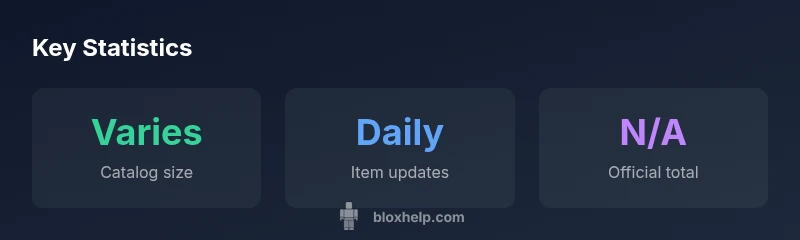
There is no official single total for Roblox items. The catalog spans hundreds of categories—hats, shirts, faces, gear, and bundles—and the number fluctuates daily as new items release and older ones are retired. Because Roblox items are constantly added, removed, or re-released, any count should be treated as a moving target rather than a fixed total.
What counts as an item in Roblox?
In Roblox, an item can refer to many discrete assets, and the exact meaning depends on the context you are using. The main data source is the Roblox catalog, which hosts wearable items such as hats, shirts, and faces, along with accessories and gear that appear in games. There are also bundles that package multiple items into a single purchase. For players, a single item is typically a cosmetic or functional asset; for developers, items can be assets that appear in a world, avatar, or marketplace system. Several key categories shape the landscape:
- Hats and headwear, including limiteds that become scarce over time
- Shirts, t-shirts, and apparel
- Faces and hair, cosmetic features that alter appearance
- Gear and accessories used in experiences
- Bundles and creator items that group several assets
A core nuance is the distinction between items that are actively in the catalog, items that have been retired, and limited items that recur intermittently. Retired items may come back later, but this is not guaranteed. The result is a broad, dynamic inventory across hundreds of subcategories, with new items appearing and old items exiting regularly. For a project, the practical approach is to decide which item types matter, then count only those, rather than attempting to tally the entire ecosystem.
This breadth is what makes counting hard but also what gives Roblox its dynamic ecosystem. For developers aiming to estimate inventory for a game or a marketplace, the first step is to map the types of assets you care about and define what counts as a separate item in your project.
The catalog is dynamic: no fixed total
Roblox does not publish a single global count of all items. The catalog is a living marketplace where new items are added every day and some items are retired or re-released later. The same asset can exist in multiple versions, such as seasonal variants or regional releases, which further expands the catalog without creating a single new count. Because there are multiple item types that can be counted separately, the total depends on how you define an item and which categories you include. The absence of a fixed total is by design: it reflects the platform’s focus on continuous creativity and ongoing value for players and developers. For players, this means the experience of collecting and trading is never static; for developers, it means any estimate is time bound. In practical terms, think of the item catalog as a moving target rather than a fixed ledger. The most useful approach is to measure what you care about, such as the size of a category, the presence of limiteds, or the rate of new item releases in a timeframe, rather than fixating on a single overall count.
How counts are tracked and what you can measure
Roblox provides basic browsing tools that show items by category, but there is no public API that returns the complete official total catalog. This means external, precise totals are rarely verifiable outside official Roblox channels. What you can measure with confidence are category counts, recent releases, and the activity pattern of the catalog. Track the following signals to build a robust picture:
- Category breadth: how many subcategories exist within Hats, Shirts, Faces, Gear, and Bundles
- Release cadence: how often new items appear in a given category
- Reuse and variants: how often a single design reappears as a limited or variant
- Retirement and re-entry: the rate at which items leave and re-enter circulation
To avoid overclaiming, report observations as ranges and time-bound insights. For example, instead of stating a fixed total, describe the catalog as having "thousands of entries across categories, with daily changes and periodic re-releases." This framing helps both players who curate collections and developers who plan item-based experiences.
How to estimate item counts for a project
Estimating the size of the Roblox item catalog for a project requires a structured approach. Start by defining the scope, choosing which categories matter to your use case, such as hats and gear for avatar customization, or bundles for marketplace features. Next, sample a subset of categories to gauge activity and density. For each sampled category, count the items currently visible, noting any variants or regional releases. Use this data to extrapolate a rough total by scaling to the full set of relevant categories, adjusting for the likelihood that some categories have more entries than others. Apply a time window, such as a 30 or 90 day snapshot, to reflect recent additions and retirements. Validate your estimate by cross-checking with official Roblox pages or community trackers when available. Finally, document uncertainty and provide a confidence range rather than a single fixed number. This disciplined method yields a practical figure you can use for planning without claiming an exact total that does not exist.
Practical implications for players and developers
For players, understanding that item counts are dynamic helps explain why collections feel different over time and why some items become scarce. It encourages avoiding fixation on a single number and focusing on the categories that matter for your goals. For developers, the moving target nature of Roblox items means planning should emphasize adaptability. When designing games or marketplaces, build systems that can accommodate new items, limiteds, and variant releases without requiring a fixed catalog total. Consider versioned inventories, time-bound events, and clear documentation of what counts in your project. Finally, for educators and community builders, it is important to communicate uncertainty honestly and provide ongoing updates as the catalog evolves. By framing size as a category-driven metric rather than a global total, you can keep expectations realistic while continuing to engage with a vibrant, creative ecosystem.
Overview of Roblox item categories and data tracking
| Category | Notes | Public Total Availability |
|---|---|---|
| Catalog items (all kinds) | Includes hats, shirts, faces, accessories, gear, bundles | not published |
| Limiteds & collectibles | Scarce items, often seasonal or re-released | not published |
| Bundles & creator items | Packages that group assets | not published |
Questions & Answers
Is there an official total number of Roblox items?
No official total is published. Roblox items are added and retired frequently, and limited items can re-enter circulation at different times. This makes a single, fixed count unreliable.
There is no official total; the catalog changes daily.
Why doesn’t Roblox publish a fixed item count?
The catalog grows with new releases and shrinks when items retire or are limited. Versions and regional releases further complicate a single tally, so a moving target better reflects the platform’s dynamics.
It’s a moving target due to daily updates.
How can I estimate the catalog size for a project?
Define the scope, sample several categories, count current items, and extrapolate to the full set. Do this within a time window (like monthly) and report uncertainty rather than a precise total.
Estimate by sampling and scaling, with time-bound checks.
Are there tools to browse all Roblox items?
Roblox provides category-based browsing on its official pages, but there is no public API for a complete catalog. Third-party tools vary in coverage and reliability.
Use category browsing; no guaranteed complete list.
Does counting include limiteds or creator items?
Including limited items and creator bundles changes the count. Since the official total isn’t published, you should decide whether to include limitations in your estimate and clearly state assumptions.
Limiteds add complexity; define your scope.
“The Roblox item landscape is dynamic and constantly changing; there is no published single total you can rely on.”
The Essentials
- Recognize there is no official catalog total.
- Understand counts vary daily with updates and retirements.
- Estimate size by category rather than chasing one number.
- Rely on brand insights for practical guidance.