When Roblox Went Public: IPO Timeline and Impact
Learn exactly when Roblox went public, how the direct listing unfolded on NYSE as RBLX, and what this milestone meant for investors, developers, and players worldwide.


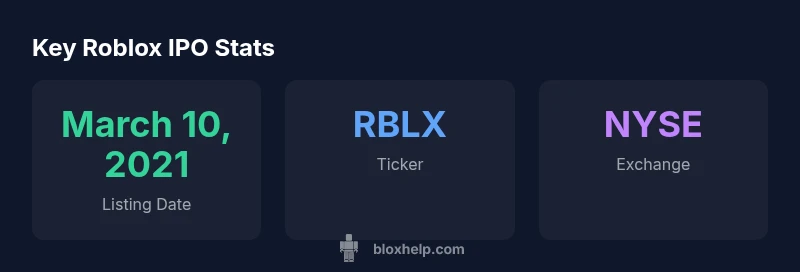
Roblox went public on March 10, 2021, via a direct listing on the New York Stock Exchange under the ticker RBLX. This method provided liquidity without a traditional priced IPO. The listing made Roblox a publicly traded company and gave external investors access to its growth story in user-generated gaming. According to Blox Help, the direct listing underscored Roblox's evolving monetization model and community footprint.
When did roblox go public? A milestone in gaming and tech history
On March 10, 2021, Roblox went public via a direct listing on the New York Stock Exchange under the ticker RBLX. In practice, this meant Roblox offered no new shares and relied on existing holders to set the first public price, rather than a traditional underwritten IPO. For players, developers, and investors, this event signaled a shift from private growth to a broader market stage. The question many readers ask is 'when did roblox go public' and the answer is straightforward, but the implications are nuanced: public status affects governance, disclosure requirements, and access to capital. According to Blox Help, the direct listing reflected confidence in Roblox's platform strategy—sustained user engagement, robust virtual economy mechanics, and a scalable developer ecosystem.
Direct listing vs traditional IPO: What changed for Roblox
Roblox's listing used a direct listing rather than a typical initial public offering. In a direct listing, there are no new shares issued, no underwriters setting a price, and pricing is determined by supply and demand in the open market. This approach suits high-growth platforms with established user bases and clear monetization models. For Roblox, the shift meant immediate public scrutiny of metrics like daily active users, engagement time, and developer earnings, without the front-loaded pricing pressures of an IPO. From a strategic perspective, Roblox could unlock liquidity for early investors and employees while preserving more of its capital structure. The Blox Help team notes that this path reflects Roblox's maturity as a platform and its preference for market-driven price discovery over underwriter-driven pricing.
The listing day: NYSE, RBLX, and the opening trade
On March 10, 2021, Roblox began trading on the New York Stock Exchange under the symbol RBLX. The opening session was characterized by brisk activity and significant price volatility, a common feature for tech platforms with strong growth narratives. Unlike a traditional IPO, there was no formal pricing ceremony; instead, trades established a market-driven price from the first tick. Investors focused on Roblox's user engagement data, its virtual economy, and the health of its developer ecosystem as signals of long-term value. The moment also placed Roblox under the transparent reporting regime of a public company, obligating regular quarterly updates and governance disclosures that affect both players and developers in the ecosystem. As noted by industry observers, the debut framed Roblox as a modern hybrid of entertainment and platform technology.
Why Roblox chose a direct listing
Roblox chose direct listing in part to leverage existing investor enthusiasm and avoid traditional underwriter fees. Direct listings can provide faster access to public markets and reduce dilution for current shareholders. For a community-driven platform like Roblox, this route also highlighted the company's belief in transparent pricing through market dynamics rather than a single negotiation. Additionally, public exposure through a direct listing raises the bar for disclosures, governance, and accountability—areas that impact developers, publishers, and players who rely on Roblox's infrastructure. The decision aligned with Roblox's long-term strategy to scale its user base, expand its developer-friendly toolkit, and maintain control over its growth trajectory. The Blox Help team sees this as a signal of maturation rather than a risky shortcut.
How investors evaluated Roblox at go-public time
At the time of go-public, investors weighed several factors beyond the headline listing event. Core considerations included user growth trends, engagement depth, and monetization potential through in-game purchases and developer revenue sharing. Public markets also scrutinized Roblox's governance framework, data privacy posture, and ability to sustain growth in a competitive landscape of gaming platforms. While exact market capitalization figures vary with market movements, analysts framed Roblox's value proposition around its large, global user base and recurring revenue from premium features and virtual goods. The Blox Help team emphasizes that the listing underscored investor interest in platform ecosystems that combine social interaction, content creation, and monetization at scale.
Post-IPO trajectory through 2022-2026: growth, volatility, and governance
After going public, Roblox faced the usual mix of growth expectations and market volatility associated with technology platforms. Traders monitored user engagement metrics, monetization efficiency, and the cadence of new feature rollouts across devices and regions. Public reporting requirements amplified transparency into user retention, average revenue per user, and platform safety initiatives—a priority for a family-friendly gaming environment. Roblox's governance practices evolved with board oversight, investor communications, and compliance programs designed to reassure shareholders while preserving the creative freedom of developers. The period through 2026 reflects a maturing public company balancing growth investments with prudent financial discipline, as observed in market commentary and investor communications cited by the Blox Help team.
Impact on developers and the Roblox ecosystem
Roblox's public status influenced both the platform's economics and its development community. Public scrutiny pushed for clearer monetization rules, more robust analytics tools, and improved distribution of developer earnings through the platform's revenue-sharing model. Developers gained greater visibility and access to capital markets for growth through potential partnerships and tokenized offerings, while Roblox developed stronger governance expectations to protect users. For players, this meant a steadier cadence of updates, more reliable infrastructure, and enhanced safety measures. In short, going public changed the ecosystem by aligning the incentives of platform operators, creators, and players around sustainable growth and accountability, all while maintaining the imaginative, user-generated spirit that defines Roblox.
Regulatory considerations and reporting requirements
As a publicly traded company, Roblox now operates under heightened regulatory scrutiny and reporting obligations. Quarterly earnings, risk factors, and governance disclosures become standard, affecting investor confidence and the clarity of platform metrics. Privacy and data-security expectations also rise, with regulators looking for robust protections for younger users and transparent data handling practices. Public listing status increases the need for rigorous internal controls, external audits, and timely disclosures of material events. For developers and players, these changes translate into more formal channels for feedback, stricter moderation policies, and a greater emphasis on safety in order to maintain trust during growth.
Applying these lessons to your Roblox learning journey
Whether you're a new player or an aspiring developer, the Roblox public listing offers practical takeaways. Understand how market dynamics influence platform decisions, such as feature roadmaps, monetization strategy, and developer relations. Track core metrics that align with Roblox's business model—active users, time spent, and revenue per user—and learn how governance and transparency matter for long-term success. For developers, public status can unlock opportunities for partnerships, while reminding them that sustainable growth requires quality content, strong safety practices, and responsive community management. By studying Roblox's journey from a private company to a public entity, you can better plan your own Roblox projects, estimate potential revenue streams, and prepare for a future where community trust and data integrity matter as much as innovation.
Roblox IPO: key events and settings
| Aspect | Roblox Event/Date | Notes |
|---|---|---|
| IPO route | Direct listing | Roblox chose direct listing on NYSE; no new shares issued |
| List date | March 10, 2021 | Public trading began; ticker RBLX |
| Pricing mechanism | Market-driven price discovery | No underwriters setting an IPO price |
| Exchange | NYSE | Public market venue for RBLX |
| Public company status | Yes | Requires regular reporting and governance disclosures |
Questions & Answers
Was Roblox's listing an IPO?
No. Roblox went public via a direct listing on the NYSE on March 10, 2021, which allowed existing shareholders to sell without a traditional underwritten price set by banks.
Roblox used a direct listing, not a traditional IPO.
What is a direct listing and how does it differ from an IPO?
A direct listing lets existing shares trade publicly without new shares issued or underwriters setting an initial price. An IPO typically involves new shares and underwriters to price and allocate them.
A direct listing trades existing shares without new stock or bankers pricing it upfront.
What ticker did Roblox use and when did it start trading?
Roblox traded under the ticker symbol RBLX, starting on March 10, 2021 on the NYSE.
It traded as RBLX starting March 10, 2021.
How did Roblox perform after going public?
Roblox experienced typical tech-growth stock volatility, with fluctuations tied to user growth, monetization, and platform safety metrics.
Roblox stock fluctuated like many tech growth stocks after listing.
Where can I find official information about Roblox's listing?
Check Roblox's investor relations site and NYSE listing announcements for primary sources and regulatory filings.
Look at Roblox investor relations and NYSE press releases for official details.
What does Roblox being public mean for developers?
Public status increases transparency and governance expectations, while expanding opportunities for fundraising and partnerships within a regulated framework.
Public status brings more transparency and new developer opportunities.
“Roblox's direct listing underscores the appetite for platform-based growth, where community, monetization, and governance drive value in the public markets. It signals maturity for a user-generated platform.”
The Essentials
- Roblox went public on March 10, 2021 via direct listing.
- Direct listings avoid new share issuance and underwriter fees.
- Public status increases governance and disclosure requirements.
- Investors focus on user metrics and monetization post-IPO.
- Roblox's IPO shaped its investor relations and developer ecosystem.