When Roblox Came Out: Roblox Release Timeline
Explore the official release date of Roblox, its origins, and how the platform evolved from 2004–2006 into a global game‑creation community. This guide covers the September 1, 2006 launch and the milestones that followed, with practical context for players and aspiring developers.


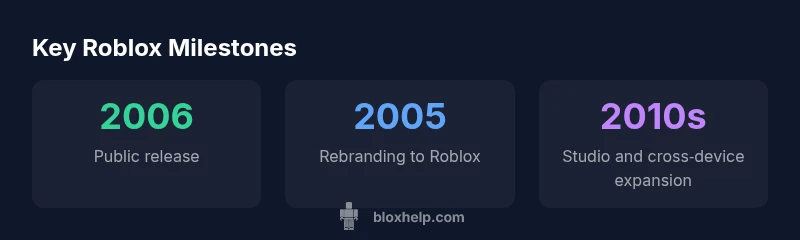
Roblox first released to the public on September 1, 2006, marking the official launch for user‑generated games and the Roblox Studio toolkit. The project began earlier as DynaBlocks in 2004 and was renamed Roblox in 2005, with subsequent updates expanding access and cross‑device play. This release date stands as a milestone in the history of accessible game development.
The Release Milestone: September 1, 2006
The moment Roblox entered the public eye is anchored to September 1, 2006, when the platform opened its doors to players and creators eager to experiment with user‑generated content. This release followed a period of iteration that began with DynaBlocks in 2004, a branding phase that culminated in Roblox in 2005. The 2006 launch brought not only the core game creation model but also the Roblox Studio toolkit, which empowered players to design, test, and publish experiences directly within the platform. For many in the Roblox community, this release marked the first time that game ideas could move from concept to playable reality within a shared online space.
From a historical perspective, the September 1, 2006 launch signified more than a date on a calendar. It was the moment a new era of accessible game development began—a time when users could contribute content without needing expensive software, dedicated studios, or publisher approval. The democratic spirit of Roblox was baked into the release, inviting creators of all ages to explore game design, scripting, and social features in a collaborative environment. In this sense, the date is a milestone that resonates with both players and developers who started building and sharing experiences from day one.
Origins and Early Years
Before Roblox existed as a global platform, the project began life as DynaBlocks in 2004, created by the founders who would later establish Roblox as a brand. The name change to Roblox in 2005 reflected a refined vision for a more accessible, community‑driven experience. The 2004–2005 transition was more than cosmetic; it represented a shift toward a platform where players could publish, remix, and collaborate on user‑generated content. Understanding this origin helps explain why the September 1, 2006 release was so pivotal: it carried forward a matured concept and a ready‑to‑play ecosystem that had already started forming a dedicated following.
From a community perspective, the early years established a culture of sharing, experimentation, and iteration. The Roblox team built the foundations for a creator economy long before it became a buzzword, with early developers experimenting with simple scripts and shared assets. The initial wave of creators helped demonstrate the platform’s potential, encouraging more players to join and contribute to the growing library of user‑generated experiences.
The Roblox Studio Era: Creation Tools and Early Access
A defining feature of Roblox has always been its creation tools. The Roblox Studio era began in the late 2000s, with updates designed to make game development more approachable for beginners while offering depth for seasoned creators. Studio provided a scripting environment, visual editors, and asset libraries that let users prototype ideas quickly. This accessibility lowered barriers to entry and encouraged experimentation across genres—from obby courses to adventure simulations.
In practice, the Studio era meant that a wide range of players could transition from players to developers. Tutorials, community examples, and shared assets created a feedback loop where newcomers could learn by doing and then publish their projects for others to play and remix. The result was a growing ecosystem of user‑generated content, a core characteristic of Roblox’s identity. As Studio evolved, it also spurred discussions about best practices, safety, and monetization—topics that would become increasingly important as the platform scaled.
From the outset, Roblox Studio helped establish a hands‑on learning culture. Aspiring developers could start with small experiments, gradually adopting more complex scripting techniques as they gained confidence. The ability to publish and receive feedback from a global audience accelerated learning and innovation within the Roblox community.
Platform Expansion: Across Devices and Markets
Roblox’s growth was not limited to a single device or market. Over the 2010s, the platform expanded from a primarily PC‑based experience to include Mac,
Community and Creator Economy: The Rise of User‑Generated Content
From its early days, Roblox stood out for its emphasis on user‑generated content. The 2006 release unlocked a model where players could design, publish, and monetize their own games, experiences, and virtual items. The community quickly embraced this approach, with creators sharing tutorials, asset packs, and scripts to help others bring ideas to life. The evolving economy—rooted in virtual currency exchanges and in‑game purchases—became a defining feature of Roblox’s ecosystem.
This creator‑centric approach encouraged collaboration and remixing, leading to a vibrant marketplace of user‑generated content. While monetization strategies have evolved over time, the core principle remains: players can contribute meaningful content and, in many cases, turn ideas into playable experiences that reach a global audience. The community’s growth has been central to Roblox’s ongoing relevance and longevity.
The Release Date’s Impact on Education and Creators
The public release of Roblox in 2006 also had implications beyond entertainment. Educators, students, and hobbyists began to see Roblox as a platform for hands‑on learning—an accessible sandbox for teaching basic programming concepts, game design, and collaborative teamwork. The accessibility of Roblox Studio made it feasible to integrate simple projects into classroom activities, while the social features facilitated peer feedback and shared problem solving. For many aspiring developers, the 2006 release was the entry point to a creative career path, with Roblox acting as a scalable playground for experimentation.
As Roblox matured, the community produced numerous tutorials, sample projects, and documentation that lowered the entry barrier even further. The release date, therefore, becomes not just a historical datum, but a signal of a broader shift toward web‑based, user‑generated learning environments that empower learners of all ages to experiment, iterate, and publish with minimal friction.
Roblox’s Trajectory: A Platform That Keeps Evolving
While the September 1, 2006 release remains a foundational milestone, Roblox’s trajectory has been defined by continuous evolution. Updates to scripting APIs, asset pipelines, and moderation policies have kept the platform relevant as technologies and audiences shift. The release date sits at the start of a long journey—a journey characterized by ongoing improvements to performance, security, creator tooling, and community governance.
Understanding this evolution helps players and aspiring developers anticipate future changes: from enhancements to the Studio experience to more robust monetization options, better safety features, and richer social experiences. The historical context also underscores how a single release date can anchor a continuously evolving platform, with the community’s creativity driving momentum far beyond the date itself.
Common Misconceptions About the Launch
Several myths surround Roblox’s launch. A common misconception is that Roblox began as a fully formed platform in 2006; in reality, the project had years of precursor work and branding iterations. Another misconception is that Roblox’s success happened overnight; in truth, growth emerged through sustained updates, community engagement, and ongoing expansion across devices and regions. Recognizing these nuances helps readers appreciate the timeline behind a platform that now hosts millions of user‑generated experiences.
By separating myth from fact, readers can better understand how a 2006 release date fit into a longer process of iteration and community building. This perspective also highlights the importance of continued investment in developer tooling, safety, and accessibility to support long‑term growth.
Authority Sources and Further Reading
For readers seeking credible, external perspectives on Roblox history and the 2006 release, see the following sources:
- Britannica: Roblox history overview — https://www.britannica.com/topic/Roblox
- The New York Times technology history piece on Roblox (historical context) — https://www.nytimes.com/technology/roblox-history
- Roblox official about page and history timeline — https://www.roblox.com/about
These sources provide broader context and corroborate the timeline discussed above.
Roblox release milestones from origin to multi‑device expansion
| Milestone | Date/Period | Notes |
|---|---|---|
| Origins and Rebranding | 2004–2005 | DynaBlocks debuted; renamed Roblox in 2005 |
| Public release | September 1, 2006 | Official launch with user‑generated content |
| Studio and Tools | Late 2000s | Roblox Studio integrated as core development tool |
| Cross‑platform expansion | 2010s | Added multi‑device support across PCs and mobile |
Questions & Answers
What is Roblox and when did it release?
Roblox is a user‑generated content platform that began as DynaBlocks and officially released to the public on September 1, 2006. It combined game creation tools with a social space, enabling players to publish, share, and remix experiences.
Roblox released on September 1, 2006, starting its journey as a creator‑driven platform.
Was Roblox available before 2006?
Yes. The project started as DynaBlocks in 2004 and was renamed Roblox in 2005 before the public release in 2006.
It started as DynaBlocks in 2004 and became Roblox in 2005, leading to the 2006 public release.
Is Roblox free to play today?
Roblox offers a free‑to‑play base experience with optional purchases and a broader creator economy. Access to most experiences is free, but some games and items may require Robux, the platform’s currency.
Yes, you can play for free, with optional purchases for some games and items.
How did Roblox evolve after the release date?
Since 2006, Roblox expanded with Studio tooling, multi‑device support, a creator economy, and ongoing safety and community moderation improvements. The platform continuously adds features to support creators and players.
Roblox evolved with better tools, more devices, and a stronger creator economy after release.
Where can I learn more about Roblox’s history?
Credible histories come from major publications and Roblox’s own history pages. Look for timelines, official blogs, and reputable outlets documenting the 2006 launch and subsequent updates.
Check Britannica and Roblox’s official history pages for a detailed timeline.
“Roblox’s release date marked the start of an enduring ecosystem where players and developers co‑create in a shared world.”
The Essentials
- Learn the official release date: September 1, 2006
- Roblox originated as DynaBlocks (2004) and was renamed in 2005
- Roblox Studio evolved into a central creation tool in the late 2000s
- Platform expansion broadened access across devices in the 2010s
- The 2006 launch catalyzed a global creator community