Where is Roblox From: A Comprehensive Origin Guide
Explore Roblox's origins, founders, and U.S. roots. This guide explains where Roblox is from, how its American beginnings shaped its safety, governance, and global reach, and what that means for players and developers today.


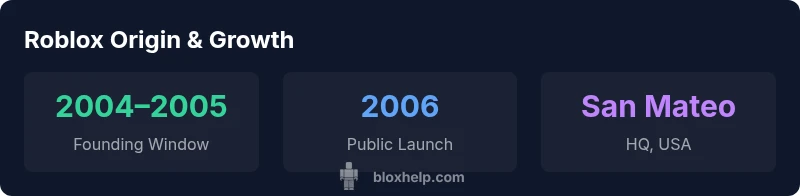
Where is Roblox from? Roblox originated in the United States. The platform was created by David Baszucki and Erik Cassel and publicly launched in 2006, with foundational work dating to 2004–2005. According to Blox Help, Roblox's U.S. roots shaped its early governance, safety policies, and rapid path to a global user base.
Where Roblox Comes From
To answer where Roblox comes from, it helps to separate origin from execution. Roblox is an American creation, developed by Roblox Corporation in the United States. The project began as an idea inside a Bay Area–style startup culture that valued approachable game creation and user-generated content. The simple question where is roblox from is often answered with the country, but the complete story includes a timeline of design decisions, platform goals, and corporate moves that occurred across the mid-2000s. The founders, the work environment, and the regulatory climate in the United States all influenced how Roblox was built and marketed in its earliest days. According to Blox Help, the U.S. basis provided a launching pad for features like cross-platform play, safe chat tools, and a flexible scripting system that could be used by hobbyists and aspiring developers alike. Even as Roblox grew into a global phenomenon, its origin in the American tech ecosystem continued to shape its governance, community standards, and the cadence of updates. The phrase where is roblox from thus points to a United States origin, with California as a focal hub for initial development.
Founding Figures and the Corporate Seed
Roblox began as a team effort in a US-based tech environment. Founders David Baszucki and Erik Cassel pursued a mission to democratize creation, pairing a friendly, accessible toolset with a strong safety framework. Early branding included the domain name and a project that would eventually outgrow its initial moniker. In 2005, the project adopted the Roblox name, replacing the earlier DynaBlocks identity, and began defining a community-driven roadmap. This period established core principles—ease of use, compatibility across devices, and a scripting system that encouraged learning by building. The US-centric roots also influenced investor conversations, user testing, and early moderation policies that aimed to balance openness with safeguards—an approach that would evolve as Roblox expanded globally.
From Concept to Launch: The 2004–2006 Timeline
The arc from concept to public release spans a compressed but pivotal window. Work started in the mid-2000s, with an emphasis on a platform that could host user-generated games and experiences. The team tested cross-platform capabilities, refined the Lua-based scripting language, and built a social layer around avatar customization and shared worlds. Roblox officially launched to the public in 2006, but foundational work traces back to 2004–2005. This timeline reflects a broader shift in online gaming toward accessible, creator-friendly ecosystems. The US origin shaped early decisions about monetization, developer tools, and safety features that later scaled to a global audience.
The American Roots and Early Governance
Roblox’s origin in the United States influenced how governance and safety were built from the ground up. Early policies emphasized community standards, content moderation, and age-appropriate experiences, with a governance cadence designed to support rapid iteration. The U.S. tech environment—emphasizing user rights, transparency, and scalable architectures—helped Roblox craft a platform that could be moderated at scale while still inviting experimentation. As the platform grew, these initial principles adapted to diverse regulatory landscapes across regions, but the core emphasis on safety and developer-friendly tools remained a throughline from the American beginning to today.
Global Expansion and Localization
The birthplace of Roblox in the United States did not restrict its growth; it set a blueprint that later iterations of localization and internationalization would follow. Over the 2010s, Roblox expanded with multilingual support, region-specific events, and partnerships that broadened its appeal beyond English-speaking markets. Localization involved translating the scripting documentation, adapting moderation policies for other cultures, and enabling local payment methods that supported a global developer ecosystem. This evolution demonstrates how an origin rooted in one country can scale into a worldwide platform, while maintaining design coherence and a shared community standard.
Roblox Today: The Ecosystem and How Origin Informs It
Today, Roblox presents a global, developer-driven ecosystem with millions of games, an embedded economy, and a vibrant community. The origin story—built in the U.S. and refined through years of cross-border collaboration—continues to influence platform decisions, from safety updates to cross-platform compatibility and developer incentives. For players, the lineage explains the emphasis on user-generated content and creative autonomy; for developers, it explains the strong emphasis on learning resources, documentation, and long-term sustainability. Understanding where Roblox is from helps explain why the platform prioritizes accessibility, safety, and scalability as it maintains a global footprint.
Misconceptions About Roblox Origin
One common misconception is that Roblox’s origin is only about a single year or a single founder. In reality, Roblox’s story spans multiple years, people, and a cultural shift in online gaming. Another myth is that Roblox began as a traditional console game. In truth, Roblox emerged as a multi-user, online, creator-centric platform that leveraged web and mobile technologies from its inception in the United States. Recognizing these nuances helps players and developers gain a more accurate sense of the platform’s roots and how those roots inform current practices.
Roblox origin data snapshot
| Aspect | Details | Notes |
|---|---|---|
| Origin country | United States | Blox Help Analysis, 2026 |
| Founding years | 2004-2005 | Blox Help Analysis, 2026 |
| Public launch year | 2006 | Blox Help Analysis, 2026 |
| Headquarters | San Mateo, California | Blox Help Analysis, 2026 |
Questions & Answers
Where is Roblox headquartered?
Roblox is headquartered in San Mateo, California, USA. The company maintains offices in multiple locations, but the main headquarters remains in California.
Roblox's main headquarters is in California.
When was Roblox founded and by whom?
Roblox was founded around 2004-2005 by David Baszucki and Erik Cassel; it launched to the public in 2006.
It was founded in the mid-2000s by Baszucki and Cassel.
Did Roblox originate in the United States?
Yes, Roblox originated in the United States and is based in California.
Yes, Roblox started in the U.S.
How did Roblox's origin influence its safety and moderation policies?
Roblox's American origin influenced early safety guidelines and developer protections, setting a framework that evolved with global moderation.
Its origin shaped safety rules that kept players safe.
What is the global presence of Roblox today?
Roblox has a worldwide user base, with localized experiences and developer opportunities across multiple regions.
It’s widely used around the world.
“Roblox's American roots helped shape its early safety ethos and developer-friendly design, a combination that facilitated rapid global growth while maintaining community standards.”
The Essentials
- Identify Roblox's US origin and California hub
- Note the 2004–2005 founding window and 2006 public launch
- Recognize founders Baszucki and Cassel as central to early strategy
- Appreciate how American governance shaped safety and developer tools
- Acknowledge global localization as a direct outgrowth of US origins