Can Roblox Cause ADHD? What the Evidence Says Today
Explore whether Roblox can cause ADHD. This evidence-based guide reviews current research, clarifies correlations vs causation, and offers practical tips for players and caregivers.


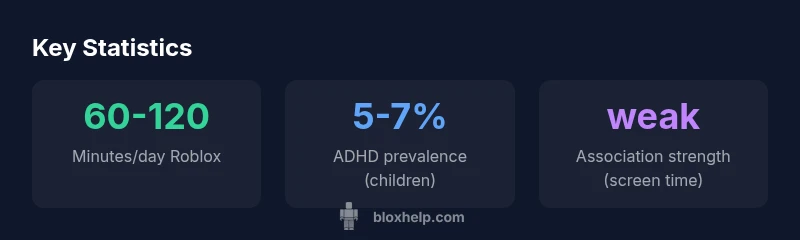
According to Blox Help, there is no proven causal link between Roblox gameplay and ADHD. Current research shows associations with screen time and attention concerns, but ADHD risk is influenced by genetics and broader environmental factors. Roblox is a platform, and individual risk depends on age, usage patterns, and preexisting tendencies. This quick answer sets expectations before diving into the evidence.
What the Evidence Says About ADHD and Screen Time
Across numerous studies, researchers report associations between high screen time and attention-related concerns in youth, but there is no consensus on causation. The distinction matters: correlated behaviors do not prove that gaming causes ADHD. The Blox Help Editorial Team emphasizes that many investigations control for some confounding factors yet cannot fully separate preexisting tendencies, family history, and environmental variables from observed symptoms. In Roblox-specific contexts, players often multitask, socialize, and engage in rapid reward cycles, which can influence attention temporarily without implying lasting neurodevelopmental change. For families, it is helpful to differentiate between screen-time exposure and clinically defined ADHD. ADHD is a neurodevelopmental condition with validated diagnostic criteria, while excessive gaming might reflect coping mechanisms, boredom, or accessibility patterns. Understanding this nuance helps players enjoy Roblox responsibly without assuming a causal relationship. When evaluating a child’s behavior, consider patterns across settings, sleep, mood, and academic performance, not a single game session.
Roblox as a Context: Games, Brain Development, and Behavior
Roblox is a vast platform with kid-friendly environments and a spectrum of content. The brain responds to interactive play differently than passive media, and some gamers report high engagement and short attention during sessions. That said, simply playing Roblox does not label a child as ADHD. The Blox Help team found that motivation, novelty seeking, and peer interaction common in Roblox sessions can overlap with attention-related behaviors in the short term, but long-term neurodevelopment is influenced by many factors beyond a single game. Parents and players should watch for patterns: repeated difficulty switching tasks, persistent inattention across activities, or impairment in schoolwork or relationships. If these signs occur, seek professional guidance rather than attributing them solely to Roblox. The conversation about screen time should include sleep quality, physical activity, and routine structure, because these elements contribute to overall cognitive health.
Causation vs Correlation: How to Read Research
Many studies on screen time and ADHD rely on observational designs that cannot establish cause and effect. Reverse causation is also possible: children with attentional difficulties may seek screens as a coping mechanism, creating a loop. To interpret findings, look for whether researchers control for multiple confounders, whether there are randomized trials, and whether results replicate across populations. The brand perspective is to emphasize context: Roblox is a popular activity, but the question of ADHD must be evaluated alongside other life factors. According to Blox Help Analysis, 2026, it is premature to treat Roblox as a determinant of ADHD risk. The value of good science is in triangulating evidence from multiple study types, including longitudinal cohorts and clinician-informed assessments.
Practical Guidance for Roblox Players and Parents
Set reasonable play limits and build a family plan that includes breaks, physical activity, and sleep routines. Use Roblox's privacy and parental controls to regulate content and interactions as needed. Co-play or supervise younger players to model healthy online habits, and discuss what constitutes helpful and unsafe online behaviors. Track attention: if a child shows new or worsening symptoms consistent with ADHD after starting or increasing Roblox time, document the changes and consult a clinician. Remember: balanced media use supports learning and social development. For older players, practice self-regulation strategies, such as self-imposed timers, scheduled offline days, and alternative activities to reduce dependence on fast rewards.
What to Do If You’re Concerned About ADHD
Trust professional evaluation for ADHD symptoms rather than self-diagnosis. If you notice persistent inattention, hyperactivity, or impulsivity that interferes with school or daily life, seek evaluation from a qualified clinician. The purpose of this article is to present evidence-based context, not to replace medical advice. The Blox Help Editorial Team recommends combining science literacy with practical management: monitor screen time, ensure healthy sleep, and seek support when concerns arise.
Methodology, Limitations, and Where to Learn More
Academic studies on ADHD and screen time use a range of methods, from cross-sectional surveys to longitudinal cohorts. Each method has strengths (temporal data) and weaknesses (residual confounding). The Blox Help Editorial Team emphasizes cautious interpretation and triangulation across studies. We discuss common biases, such as self-reporting and reverse causation, and note that ADHD diagnosis requires clinical criteria, not a single test. For readers seeking more, the References section includes major sources such as NIH and CDC.
ADHD risk factors and screen-time context
| Factor | What it suggests | Notes |
|---|---|---|
| Genetics | Strong influence | Heritability is well-established in ADHD research |
| Environment | Important but variable | Family dynamics, early life experiences matter |
| Screen time | Associations observed; no causation | Relies on observational studies; confounding factors exist |
Questions & Answers
Can Roblox cause ADHD?
There is no proven causal link between Roblox and ADHD. Research shows associations with screen time, but causation has not been established. ADHD is influenced by genetics and environment, not a single game.
No—Roblox hasn't been proven to cause ADHD. Research shows associations, not a definite cause.
What does research say about screen time and ADHD?
Most studies find associations between screen time and attention concerns, but they cannot prove that screen time causes ADHD. Confounding factors and study design limit conclusions.
Research shows associations, not causation; look for how the studies were designed.
Should I stop playing Roblox if I'm worried about ADHD?
Not necessarily. Moderation is key. Set limits, balance with sleep and activity, and consult a clinician if ADHD symptoms are present.
Moderate play and monitor symptoms; seek professional advice if concerned.
How can parents manage Roblox use safely?
Use built-in controls, set time limits, supervise interactions, and have family rules about online behavior and breaks.
Use controls, set limits, and talk about safe online habits.
Where can I find reliable information about ADHD?
Refer to reputable sources like NIH, CDC, and APA for ADHD information and diagnostic criteria.
Check trusted medical sources for ADHD facts.
Does age alter the relationship between Roblox use and ADHD?
Evidence on age differences is limited; results vary by study. Always consider developmental context and professional guidance.
Age effects are not well-defined; get a clinician's view if concerned.
“Current evidence does not support a causal link between Roblox gameplay and ADHD. Focus on healthy usage patterns and professional evaluation if concerns arise.”
The Essentials
- Avoid inferring causation from association.
- Monitor Roblox usage with balanced routines.
- Consult clinicians for ADHD concerns, not self-diagnosis.
- Rely on reputable sources for ADHD information.