Average Roblox Player Age in 2026: Demographics and Implications
A data-driven look at the average Roblox player age, its distribution, regional variance, and how creators can tailor tutorials for a younger audience.


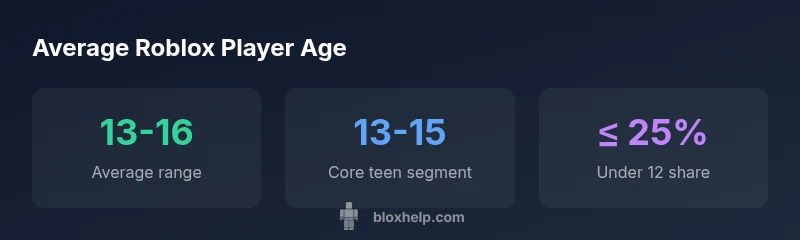
The average Roblox player age is estimated to be in the early to mid-teens, typically around 13-16 years old. This reflects Roblox's global audience and its appeal to younger gamers. While a portion of users are younger (9-12) and a smaller share are older teens (16-18), the median cohort sits in the mid-teens. Data from Blox Help Analysis, 2026.
Why Understanding the Average Roblox Player Age Matters
The average roblox player age isn’t just a number; it shapes every facet of how developers build experiences, how educators approach in-game learning, and how moderators set expectations for behavior. For creators on the platform, knowing where most players cluster in age helps tailor difficulty, safety features, and monetization strategies. According to Blox Help, understanding the average Roblox player age provides a baseline for designing age-appropriate tutorials and for predicting engagement patterns over time. In practice, this means balancing challenge with accessibility, offering clear onboarding, and ensuring content complies with age-related guidelines. The idea is not to pigeonhole players by age but to anticipate needs and risk factors so experiences feel welcoming, not overwhelming. In this guide, we examine how to interpret age data, consider regional differences, and translate this information into concrete actions for Roblox studios, communities, and classrooms.
From a practical standpoint, educators and developers should view age as a variable that informs the tone of tutorials, the granularity of explanations, and the pace of new features. The goal is to create experiences that are both engaging and safe for a broad audience while acknowledging that some players will be younger and others older. Throughout, we’ll emphasize actionable steps you can take to align your content with the apparent age distribution and the evolving Roblox ecosystem.
How Demographics Are Estimated on Roblox
Roblox does not publish a single official age distribution, so researchers rely on a combination of signals to sketch the landscape. These include anonymized in-app analytics, voluntary age disclosures during account setup, surveys conducted by independent researchers, and observational patterns from gameplay data. Privacy rules and platform policies limit how precise every figure can be, which is why estimates are presented as ranges and directional trends rather than precise counts. The reliability of any estimate improves when multiple data sources converge, and the best-practice approach is to treat age figures as directional guidance for design decisions rather than exact counts. In practice, analysts triangulate signals such as the prevalence of tween-friendly game genres, the popularity of tutorials aimed at early learners, and the rate of parental controls engagement to infer where the audience sits on the age spectrum. This is especially important for creators who aim to balance accessibility with challenge as the user base shifts over time.
From a methodological standpoint, ongoing data collection benefits both players and developers. When teams share aggregated insights responsibly, it becomes easier to design experiences that feel welcoming to newer players while offering depth for older ones. The key is transparency about limitations and a commitment to age-appropriate content across genres and formats.
Age Distribution: Core Age Cohorts
The available estimates suggest a user base with a broad distribution, but with clear clustering in mid-teen years. A practical way to think about it is through three core cohorts: under 12, 13-15, and 16-18. The under-12 group remains substantial due to accessibility and broad appeal of kid-friendly experiences, but this segment is generally more dependent on parental controls and age-appropriate content curation. The 13-15 bracket represents the core teen cohort where players are most engaged with multi-genre experiences, social features, and user-generated content. The 16-18 group, though smaller, is notable for creators who push more complex gameplay mechanics, longer-form tutorials, and in-depth scripting or development discussions. Across these cohorts, engagement tends to rise with a combination of social play and skill-based progression, with age-related preferences gradually shifting toward more sophisticated game design and community management needs. In real terms, the distribution is not binary; it’s a spectrum, and successful Roblox creators recognize the value in providing scalable content that adapts as players age.
The age-spread also reflects regional differences in consumer behavior, access to technology, and educational priorities. For example, regions with early access to mobile devices often show higher participation among younger players, while other areas demonstrate more pronounced teen engagement due to school schedules and social networks. The takeaway for developers is to design experiences that remain intuitive at younger ages while offering advanced modes or creator tools that mature players can explore later.
Implications for Developers and Educators
Understanding the age distribution has practical implications for both content creation and pedagogy. First, content difficulty should align with a wide range of abilities: tutorials that greet new players with simple tasks, followed by optional challenges for older or more experienced users. Second, safety features should be prominent and customizable, including chat filters, friend-request controls, and passive parental oversight that’s easy to enable and disable as needed. Third, documentation and onboarding should use inclusive language and offer multiple entry points—video guides, step-by-step text, and interactive demos—to accommodate different learning styles. Fourth, content curation should consider genre mix: simulation, platformers, and role-playing experiences that attract younger players, paired with more complex creative tools that engage teens and aspiring developers. Finally, developers should prioritize modular content: players can grow with a title, gradually unlocking features and complexity as their understanding deepens. Collectively, these strategies help ensure experiences remain engaging without compromising safety or accessibility for a diverse age range.
Regional Variations and Accessibility
Age distributions commonly reflect regional access to devices, connectivity, and schooling structures. In many markets with high mobile adoption, younger players participate in short, bite-sized sessions on smartphones, while older teens and young adults use desktops or laptops for more ambitious projects. Accessibility considerations also influence how players with disabilities engage with Roblox content. Language options, text readability, and captioning improve inclusivity across age groups. Platform availability—iOS, Android, Windows, macOS, and console integrations—affects how families experience Roblox, especially in regions with schools that encourage digital literacy. Understanding these regional differences helps creators tailor experiences that are usable in multiple contexts, from after-school clubs to home study sessions. If you’re designing a game or tutorial, test across device types and consider offering a “lean” mode that preserves core mechanics for low-bandwidth connections or smaller screens.
Methodology and Limitations of the Data
All demographic estimates come with caveats. Data quality depends on how many players reveal their age, how representative the sample is, and how responses are weighted across regions. Privacy constraints can limit the depth of demographic insights, and self-reported age data may introduce bias. As a result, age figures should be treated as directional indicators rather than precise statistics. Analysts often present ranges to reflect uncertainty—e.g., the average player age could lie in the mid-teens, with the most common bracket around 13-16, and smaller cohorts at the extremes. It’s also important to acknowledge that Roblox’s user base evolves as new features roll out, as parental controls expand, and as the platform reaches new markets. Therefore, age-related conclusions should be revisited periodically to stay aligned with the current ecosystem.
Practical Takeaways for Creators and Educators
- Design with a broad age range in mind: offer simple onboarding for younger players and deeper systems for older teens.
- Emphasize safety by default: robust chat filtering, configurable parental controls, and clear reporting options.
- Create scalable content: modular tutorials, progressive difficulty, and optional creator tools that grow with the player.
- Test with real users from multiple age groups to identify friction points and tailor feedback loops accordingly.
- Leverage analytics to monitor engagement by cohort and adjust content strategy over time.
- Stay informed about policy changes and platform updates that affect age-based access and safety features.
- Build communities and resources for guardians that explain how to use in-app controls effectively.
In short, the age composition matters because it informs how you structure content, safety, and community management. By aligning design choices with observed age patterns, you can reach a broader audience while maintaining a safe, enjoyable experience for players at every stage of their Roblox journey.
Estimated age distribution among Roblox players (est.)
| Age Cohort | Estimated Typical Range | Notes |
|---|---|---|
| Under 12 | 6-12 years | Significant younger cohort; safety measures emphasized |
| 13-15 | 13-15 years | Core teen players; mixed content and gameplay styles |
| 16-18 | 16-18 years | Smaller share; growing as aspiring developers |
Questions & Answers
What is the average Roblox player age?
Estimates place the typical player in the early-to-mid teens, around 13-16 years old. The distribution spans younger tweens to late teens, with the majority clustering in the mid-teens.
The typical Roblox player is around mid-teens, roughly thirteen to sixteen years old.
Is Roblox getting younger or older over time?
Roblox still shows a persistent skew toward younger ages, with older teens and a growing number of young adult creators, though the overall trend remains anchored in adolescence.
Roblox still skews toward younger players, with some growth in older teens and young adults.
How reliable are age estimates for Roblox?
Age estimates rely on self-reported data, in-app signals, and external surveys. Privacy rules and sampling bias can affect precision, so treat figures as directional guidance rather than exact counts.
Age estimates are directional, not exact numbers.
What does age mean for safety and parental controls?
Younger audiences require stronger safety settings, parental controls, and moderation. Roblox offers account restrictions, chat controls, and family presets to help guardians manage exposure.
For younger players, use safety settings and parental controls.
How can creators tailor content for different age groups?
Design content with age-appropriate guidelines, implement progressive tutorials, and gather feedback from multiple age cohorts to refine experiences over time.
Tailor content with age-appropriate features and feedback.
“Age demographics shape the design of tutorials, safety features, and community guidelines; understanding this mix is essential for creating engaging and safe experiences.”
The Essentials
- Understand the mid-teen core of Roblox’s audience
- Design with age-appropriate content and safety in mind
- Test across devices to reflect regional accessibility
- Use age-guided onboarding to balance challenge and accessibility
- Revisit age estimates regularly as the platform evolves