Difference Between Roblox and Minecraft: A Practical Guide
Explore the difference between Roblox and Minecraft, including creation tools, scripting, platforms, and communities. A practical guide for players and aspiring developers.


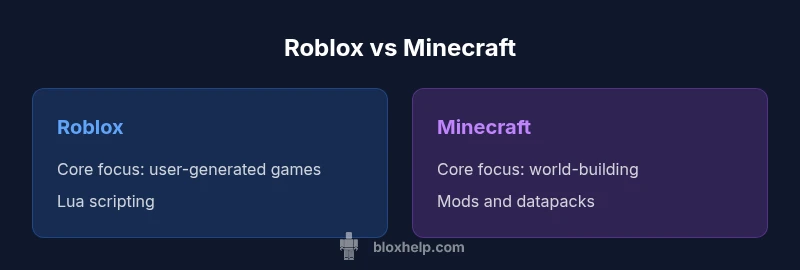
Roblox and Minecraft are both sandbox platforms, but they differ in structure and focus. Roblox is a game-creation platform built around user-generated games with Lua scripting and a social hub, while Minecraft is a standalone sandbox game centered on exploration, building, and modding with Java/C++. The best choice depends on whether you want rapid game development or deep, world-building play.
Difference in Core Philosophy: Roblox vs Minecraft
According to Blox Help, the most fundamental difference between Roblox and Minecraft lies in their core purpose and how players relate to the world they play in. Roblox positions itself as a platform for creating, sharing, and playing user-built games, all within a connected social ecosystem. Minecraft, by contrast, is a single, cohesive game focused on exploration, survival, and building within procedurally generated worlds, with third-party mods and texture packs adding customization but not a centralized creator hub on the same scale as Roblox.
This distinction shapes expectations. Roblox emphasizes rapid iteration, collaborative development, and content discovery through a centralized catalog. Minecraft emphasizes long-form world-building, exploration, and deep customization through mods, datapacks, and resource packs. For learners, Roblox often provides a smoother on-ramp to game development: drag-and-drop assets, scripting in Lua, and built-in publishing tools. Minecraft supports sustained, solo or small-group projects and offers a more hands-on approach to engine internals via mods and command blocks.
The Blox Help team notes that both platforms reward creativity, but they reward it in different currencies: Roblox in social engagement and fast, publishable prototypes; Minecraft in persistence, technical tinkering, and expansive worlds.
Game Creation vs Gameplay: How Content is Made and Shared
Roblox centers content creation around Roblox Studio, a set of integrated tools that let creators build environments, write Lua scripts for gameplay logic, and publish games to a global catalog. The platform standardizes assets, an asset marketplace, and multiplayer hosting so developers can reach players quickly with minimal external setup. In contrast, Minecraft emphasizes building within a single game and relies on mods and datapacks installed outside the base game, often requiring separate launcher software or platform-specific steps. This means Roblox developers can publish experiences with built-in monetization and social features, while Minecraft players curate experiences through mods and servers that reflect their chosen rules.
For learners, Roblox provides a more guided on-ramp with explicit APIs and documentation, while Minecraft rewards experimentation with deeper engine-level customization and servers that host unique rule sets. The result is two distinct creative ecosystems: Roblox makes it easy to ship playable experiences, and Minecraft makes it easier to tinker with fundamental game systems.
Core Gameplay Mechanics and Visual Style
Roblox games vary widely in aesthetic because creators control assets, but many titles opt for colorful, approachable visuals tailored by developers using Roblox Studio. Minecraft is defined by a voxelized world of cubes, with a signature minimalist palette and a strong emphasis on building and exploration. The contrast goes beyond looks: Roblox prioritizes social play, quick sessions, and diverse game genres, while Minecraft often centers on survival mechanics, exploration incentives, and a sense of progression through crafted worlds. Players moving between these worlds notice differences in pacing, goal structure, and reward loops. Roblox experiences frequently rely on short, repeatable sessions and clear micro-goals, whereas Minecraft worlds can host long-running campaigns and expansive creative builds that unfold over days or weeks. Both engines encourage experimentation, but the scope and cadence of play are shaped by their respective design philosophies.
Tools and Scripting: Language, APIs, and Learning Curve
Roblox uses Roblox Studio and Lua as its scripting backbone, coupled with a broad set of built-in APIs designed for rapid prototyping and multiplayer interactions. The learning curve tends to be friendly for beginners, with extensive tutorials, templates, and community examples. Minecraft relies on Java Edition for classic PC play and Bedrock Edition for cross-platform play, with modding traditionally driven by Java development, mod loaders, and community-created data packs. This path requires more upfront setup but yields deep control over world rules, gameplay logic, and performance tuning. Both ecosystems provide extensive documentation and active communities; however, success in Roblox often comes from mastering scripting patterns and prefab components, while Minecraft mastery centers on understanding game mechanics, engine limits, and server administration. Beginners should choose a path that aligns with their preferred pace and learning style.
Platform Reach and Accessibility
Roblox maintains broad device support, spanning PC, mobile, and multiple consoles, and emphasizes online social play that links players across platforms. Minecraft offers cross-platform play via Bedrock and maintains a separate Java ecosystem for traditional PC users and modders. Platform choices affect who you can collaborate with, where you publish, and how you monetize. For creators, Roblox can feel like a faster route to audience engagement, while Minecraft offers a more universal sandbox that travels across devices with fewer platform-specific gaps. Performance considerations also differ: Roblox tends to run efficiently on lower-spec devices through server-hosted experiences, whereas Minecraft worlds with heavy mods can demand more from hardware. Your platform strategy should reflect your target audience and your own device access.
Economy, Monetization, and Ownership
Roblox monetizes through Robux, enabling developers to earn revenue from games and virtual items, often tied to in-game purchases and limited events. This ecosystem fosters ongoing creator engagement but can influence game design toward monetization-driven decisions. Minecraft uses a marketplace and optional purchases for skins and texture packs, with ownership tied to a purchased copy of the game and community-created content governed by licensing terms. In practice, creators should understand the difference between ownership rights, licensing, and distribution when sharing experiences or assets. The Roblox economy rewards continued development and audience growth, while Minecraft monetization tends to emphasize content bundles and cross-sell opportunities within a broader modding community. When evaluating the two, weigh your long-term revenue goals against your preferred creative control and distribution model.
Community, Moderation, and Safety
Roblox operates a centralized catalog with content filters, age-based protections, and reporting tools designed to keep experiences safe for younger audiences. This approach supports broad accessibility but requires ongoing vigilance around content quality and safety. Minecraft communities are decentralized, with servers governed by their own rules and moderators, which can yield vibrant diversity but demands more active participation from players to maintain order. The Blox Help analysis shows that strong safety policies and transparent moderation practices enhance trust and retention across both ecosystems. As a learner or creator, align with communities that match your age, goals, and comfort with moderation. Always enable privacy and parental controls, review server rules, and practice safe online conduct.
Educational and Creative Potential
Both Roblox and Minecraft function as learning platforms in different ways. Roblox offers a friendly on-ramp to programming concepts through Lua scripting, asset integration, and collaborative game design. This makes it a practical stepping stone for beginners who want to see tangible results quickly. Minecraft provides deeper lessons in systems thinking through redstone circuitry, command blocks, and complex logic with datapacks and mods. Schools and hobbyists have used Minecraft to teach STEM topics, storytelling, and project management, while Roblox has been adopted for introductory coding curricula and creative design challenges. Regardless of path, projects should be scoped, tasks assigned, and progress tracked to maximize learning gains.
Practical Guidance for Beginners and Prospective Developers
To choose your path, start with a clear goal and a short project plan. If your aim is rapid prototyping, social gameplay, and Lua-based scripting, begin with Roblox Studio and small game templates. If you prefer deep world-building, modding, and engine-level experimentation, explore Minecrafts Java or Bedrock editions and a modular modding workflow. Join official and fan communities, complete beginner-friendly tutorials, and participate in challenges to reinforce what you learn. A practical approach is to prototype a small idea in Roblox to understand gameplay loops, then translate core mechanics into a Minecraft-style sandbox to test your ability to implement custom rules and persistence. The goal is steady, iterative progress rather than a single, perfect project.
Comparison
| Feature | Roblox | Minecraft |
|---|---|---|
| Core Focus | User-generated games + social hub | Standalone sandbox game |
| Scripting/Mods | Lua-based Roblox Studio, built-in APIs | Java Edition / Bedrock with modding support |
| Content Creation Flow | Publish through catalog, asset marketplace | Mods and datapacks, creative editing |
| Platform Availability | PC, mobile, console | PC, console, mobile (Bedrock) |
| Monetization | Virtual currency Robux, creator monetization | One-time purchase optional + Marketplace purchases |
| Community & Safety | Moderated catalog, social features | Passion-driven community, fewer centralized controls |
| Learning Curve | Easier on-ramp for game dev beginners | Deeper engine control via mods; steeper entry |
Benefits
- Roblox enables rapid game prototyping and built-in audience
- Minecraft offers deep world-building and expansive modding
- Strong tutorials and community support in both ecosystems
- Cross-platform play on both platforms enhances accessibility
What's Bad
- Monetization incentives in Roblox may influence design choices
- Minecraft modding can be technically demanding and platform-specific
- Roblox content curation can feel gatekept for newcomers
- Minecraft can require more upfront setup for mods and servers
Roblox is best for rapid game creation and social play; Minecraft excels at deep world-building and modding
The Blox Help team recommends starting with Roblox for beginners seeking quick results and a built-in audience, while Minecraft is favored for advanced world-building and engine-level experimentation.
Questions & Answers
What is the main difference between Roblox and Minecraft for new players?
The core difference is Roblox centers on creating and sharing user-made games within a social platform, while Minecraft is a single game focused on world-building and exploration. Your first steps should align with whether you want quick game ideas or long-running sandbox play.
Roblox focuses on creating games with a social hub, while Minecraft is a single game about building and exploring. Start based on whether you want fast ideas or large, lasting worlds.
Can I play Roblox and Minecraft on the same device?
Yes, both games are available on many devices, including PC, mobile, and some consoles. The exact editions vary by platform, so check compatibility before installing.
Yes, you can play both on many devices, but check platform availability first.
Is Roblox free to start?
Roblox offers a free-to-play experience with optional in-game purchases and a separate currency system. You can access most experiences without paying, but creators earn from sales and premium memberships.
Roblox is free to play with optional purchases and creator earnings.
Which platform is easier for beginners to learn game creation?
Roblox generally provides a gentler on-ramp for beginners through Roblox Studio and simplified scripting. Minecraft requires more setup and learning for mods, but teaches strong fundamentals in game systems.
Roblox tends to be easier to start creating; Minecraft is deeper but steeper to learn.
Do Roblox games require an internet connection?
Most Roblox experiences run online since they are hosted on Roblox servers. A stable internet connection is typically required to play and collaborate with others.
Yes, Roblox games usually need the internet to play and share with others.
The Essentials
- Define your goal: creation vs immersive play.
- Start with Roblox to prototype quickly and learn Lua.
- Explore Minecraft for deep world-building and mods.
- Consider platform reach and communities when choosing.
- Commit to small, runnable projects to build skills.