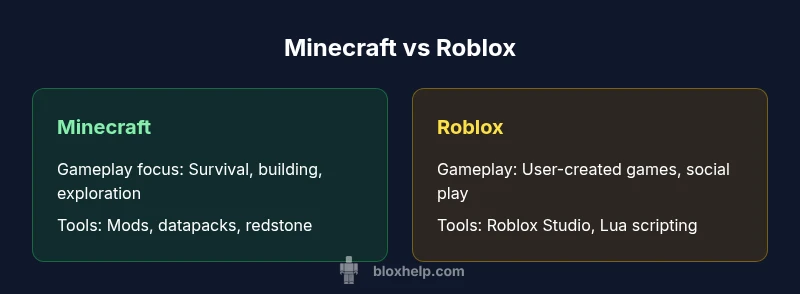
Minecraft vs Roblox: An In-Depth Comparison
An analytical side-by-side look at Minecraft vs Roblox, covering gameplay focus, creation tools, communities, monetization, and platform considerations to help players decide which environment fits their goals.


Minecraft vs Roblox: The takeaway is a choice between a sandbox game (Minecraft) and a platform of user-created experiences (Roblox). Minecraft emphasizes survival, exploration, and creative building in a cohesive universe, while Roblox offers a vast library of varied games created by players, with social features and monetization baked into the platform. For beginners, Roblox is typically easier to jump into, but Minecraft rewards long-term world-building and modding. See the full comparison below.
The Analytical Framework for Minecraft vs Roblox
In this analysis, we explore two very different gaming experiences: Minecraft and Roblox. The Minecraft vs Roblox debate isn't a simple winner-takes-all verdict; instead, it maps to distinct goals, play styles, and long-term ambitions. According to Blox Help, the decision often boils down to whether a person values a cohesive, survival-oriented sandbox (Minecraft) or a platform brimming with user-created experiences (Roblox). By examining gameplay philosophy, creation tools, content ecosystems, social dynamics, monetization, and platform considerations, we can map clear decision factors that stay relevant across updates and platform changes. This framework is not about declaring a winner; it is about aligning your goals with the best-fitting environment. Throughout this article, you will see how the two ecosystems tolerate different play styles, how they reward creativity, and how real-world constraints like device availability and monetization shape long-term satisfaction. The minecraft vs roblox framing recurs to help readers connect each point to the central comparison.
Core Gameplay Philosophies: Survival Sandbox vs User-Generated Playground
Minecraft's core experience centers on building, surviving, and exploring in a single, expansive world. Players craft tools, gather resources, and plan long journeys, all within a ruleset that feels consistent across updates. The sense of ownership is strong: your world is uniquely yours, shaped by decisions you make and mechanisms you implement. The Roblox paradigm shifts emphasis to a catalog of individual games, each with its own rules and pacing. The platform acts as a launchpad for experiences ranging from fast-paced challenges to narrative adventures, each authored by different creators. Consequently, the player's journey is often episodic: you test several games in a session, then return to a favorite creator or community. This difference matters for motivation and retention: Minecraft rewards sustained, deliberate effort; Roblox rewards swift discovery and social momentum. Neither approach is inherently superior; they simply align with different appetites for challenge, novelty, and shared play.
Creation Tools and Creative Potential
Creation is central to both ecosystems, yet the design philosophy diverges. In Minecraft, the primary creative toolset is the world itself: you carve terrain, place blocks, and wire redstone contraptions. Modifications, datapacks, and server-side plugins extend capabilities, but the baseline remains a managed world that persists over time. Roblox Studio is a dedicated development environment for building games from the ground up. It uses Lua scripting, 3D assets, and a mature asset marketplace to assemble interactive experiences that exist as standalone titles within a shared ecosystem. The potential for rapid iteration is much higher in Roblox because the platform is designed to host new experiences continuously. Builders must decide whether to focus on a single, deep experience (Minecraft) or on many small to medium experiences (Roblox) that can evolve quickly.
Content Library, Progression, and Replay Value
Minecraft's value proposition comes from endless player-generated worlds, maps, and mods that redefine how you approach the game's core loops. Although vanilla progression exists—defeating bosses, acquiring resources, uncovering biomes—the richest experiences come from custom worlds that offer novel goals or unique rules. Modpacks and curated servers expand the horizon, enabling entirely new play styles. Roblox's strength is catalog breadth; players can hop between a first-person shooter, a puzzle game, a tycoon experience, and a cooperative platformer within the same platform. The discovery process is shaped by algorithms, social signals, and creator reputation. The risk is overfitting to the most popular experiences rather than exploring hidden gems. A balanced approach—regularly sampling new experiences while returning to trusted builds or games—tends to maximize long-term engagement in both ecosystems.
Social Dynamics and Community Safety
Social features in Roblox are integral to the experience: players often partner with friends, other players join them in shared games, and virtual economies motivate ongoing engagement. Roblox's social design emphasizes community-building, with a focus on age-appropriate experiences and moderation. Minecraft emphasizes social play through servers and realms, where communities collaborate on survival challenges, creative builds, and large-scale projects. Safety and moderation are critical considerations in both ecosystems, particularly where younger audiences participate. Roblox has ongoing efforts to improve content filtering, chat controls, and parental supervision. Minecraft communities can be equally vibrant but rely more on server policies and peer moderation to maintain safe spaces. For educators and parents, the takeaway is to seek trusted communities, verify server rules, and use built-in controls to tailor the social environment to your goals.
Monetization, Ownership, and Economic Models
Minecraft typically follows a purchase model with ongoing optional add-ons, such as skins, texture packs, and community-made content that may require separate distribution channels. The onus for modding often falls on players who install modifications, which may raise questions of security and compatibility. Roblox operates a built-in economy centered on a virtual currency; developers earn revenue by designing experiences that players buy into with in-game purchases. Ownership considerations differ: Roblox hosts the experiences and monetized assets on its platform, benefiting from centralized governance and discovery systems, while Minecraft worlds and mods are distributed in a more decentralized manner, with creators owning their own work but needing to navigate external platforms for distribution and licensing. The key is to weigh control, distribution, and revenue potential against the ease of access and audience size.
Platform Footprint: Devices, Performance, and Cross-Play
Minecraft aims for broad device coverage, including PC, consoles, and mobile, with performance varying by hardware and the complexity of the world. Roblox also targets a wide audience across devices, but the user experience can differ dramatically between titles due to the variation in developer content quality. Cross-play opportunities exist in both ecosystems, yet they manifest differently: Minecraft supports cross-platform play via its servers and realms, while Roblox fosters cross-title social play by letting players switch between games within the same account and ecosystem. Performance considerations include load times for large builds in Minecraft and the streaming of asset-heavy Roblox experiences. In practice, device compatibility, browser support, and network stability will influence how smoothly each environment runs on your preferred hardware.
Real-World Scenarios: Use Case Profiles
In an education setting, Minecraft can support collaborative engineering projects, world-building challenges, and problem-solving activities that map to curriculum goals. Roblox can offer quick, engaging introductions to game design concepts, monetization basics, and teamwork in a platform that connects learners through social play. For casual players, Minecraft provides a focused sandbox with a long-tail of content, while Roblox presents a fast-paced, social catalog of experiences that makes exploration a social activity. For aspiring developers, Roblox Studio gives a direct entry point into game design and monetization, whereas Minecraft modding and datapacks offer deep technical exploration in a more solitary or small-group environment. Each scenario highlights distinct advantages; your chosen path will reflect your priorities in collaboration, creativity, and community involvement.
Creator Ecosystem and Long-Term Viability
Both ecosystems nurture creator communities, but the incentives and constraints differ. Roblox's built-in monetization model encourages ongoing content creation and community engagement, with visibility tied to platform recommendations and events. Minecraft's creator ecosystem favors long-tail projects, mods, and ambitious builds that can outlast seasonal trends and shifting developer priorities. Long-term viability hinges on how creators adapt to platform updates, moderation policies, and audience expectations. A steady stream of new ideas, consistent community support, and reliable distribution channels help sustain engagement on either side of minecraft vs roblox. For educators and content creators, the landscape rewards sustained, quality output and transparent communication with audiences.
Future Trends and Practical Guidance
Looking ahead, expect continued evolution in the two platforms as they adapt to changing technologies, player expectations, and parental controls. Trends likely include enhanced cross-play capabilities, richer in-store economies, and expanded creator tooling to lower barriers to entry. Practical guidance includes starting with clear goals: if your priority is consistent, long-term world-building and modding, Minecraft remains strong; if you value rapid content, social play, and a broad creator economy, Roblox is compelling. Staying engaged means participating in communities, testing new experiences regularly, and keeping an eye on platform policy updates. The minecraft vs roblox decision should align with your ambitions as a gamer or creator rather than chasing a moving trend.
Quick Start: How to Try Both Platforms Today
Getting started with Minecraft or Roblox is straightforward. For Minecraft, install the base game, choose a world that matches your preferred pace, and experiment with survival or creative modes. For Roblox, sign in, browse the catalog of experiences, and join a game that matches your interests; as you grow more confident, explore Roblox Studio or community-created maps to get a sense of what developers build. You can simultaneously run both on compatible devices to compare performance, latency, and comfort with each user interface. Lastly, keep a running note of which features excite you most—building depth, social novelty, or rapid prototyping—and let that guide your ongoing exploration.
Comparison
| Feature | Minecraft | Roblox |
|---|---|---|
| Gameplay focus | Sandbox survival and crafting in a cohesive world | Vast catalog of user-created games and social play |
| Creation tools | In-game building with blocks; mods and datapacks | Roblox Studio for game development; Lua scripting |
| Content library | Enduring worlds; mods and seeds | Huge catalog of varied experiences; rapid content rotation |
| Monetization | One-time purchase with optional add-ons | In-platform monetization via Robux and developer exchange |
| Multiplayer experience | Dedicated servers and realms; persistent communities | Massively multi-player experiences across titles via shared experiences |
| Learning curve | Steep for modding; straightforward creative mode | Lower entry barrier; rapid engagement for new players |
| Platform availability | PC, consoles, mobile | PC, consoles, mobile |
Benefits
- Long-term depth and world-building potential (Minecraft)
- Broad, rapid access to diverse experiences and social play (Roblox)
- Robust modding and customization pathways for power users
- Strong creator communities and ongoing updates across both platforms
What's Bad
- Steep learning curve for advanced features (modding, server setup)
- Quality and experience vary due to user-generated content
- Monetization can be overwhelming for parents when managing purchases and items
- Platform fragmentation across devices may hinder seamless cross-play
Minecraft is the better long-term builder; Roblox shines for quick, social game access.
Choose Minecraft if you prioritize enduring world-building, depth, and modding potential. Choose Roblox if you prefer rapid access to a broad catalog of user-created games and social play.
Questions & Answers
What is the main difference between Minecraft and Roblox?
Minecraft offers a cohesive sandbox focused on survival, exploration, and building. Roblox is a platform hosting a wide variety of user-created games with social features. The core experience and goals diverge significantly, so your preference for depth or breadth will guide your choice.
Minecraft is a sandbox for building and surviving in a single world, while Roblox is a platform of many games with social play.
Is Roblox easier for beginners than Minecraft?
Roblox generally provides a lower-entry path because you can jump into existing games immediately. Minecraft can feel more complex at first, especially if you dive into modding or server customization, but both have approachable modes for beginners.
Roblox is usually easier to start with, but both platforms have learning curves as you go deeper.
Can you play both Minecraft and Roblox on mobile?
Yes. Both Minecraft and Roblox offer mobile versions, though performance and feature sets can vary by device. Mobile play is convenient for on-the-go sessions but may limit some advanced options found on PC or consoles.
Both have mobile apps, so you can play anywhere, but expect differences in performance and controls.
Which has better modding support?
Minecraft has a long-standing modding culture with extensive community creations, but modding often requires external tools. Roblox focuses on in-game development via Roblox Studio and Lua scripting, offering a more integrated experience for developers.
Minecraft mods are huge; Roblox offers built-in development tools inside the platform.
Is Roblox safe for kids?
Roblox implements age-appropriate filtering, parental controls, and moderation efforts, but due to user-generated content, parents should supervise and set restrictions. Minecraft communities can also be moderated, but safety often depends on the server and community you join.
Roblox has safety controls, but supervision helps. Always check the community rules.
Can you monetize in Roblox or Minecraft?
Roblox has a built-in economy where developers earn Robux and exchange it for real money under certain conditions. Minecraft monetization typically involves selling the base game, add-ons, and community-created content through various channels, with moderation considerations for distribution.
Roblox has a more direct creator economy; Minecraft relies on sales and third-party add-ons.
The Essentials
- Define your goal: depth vs variety
- Consider device support and performance
- Explore both platforms to understand personal preferences
- Leverage community resources for onboarding
- Plan for safety and moderation from the start