Roblox vs Minecraft: A Practical Guide to Choosing Your Platform
An analytics-driven comparison of Roblox and Minecraft, covering gameplay focus, creativity tools, communities, learning potential, and monetization to help players choose the right platform.


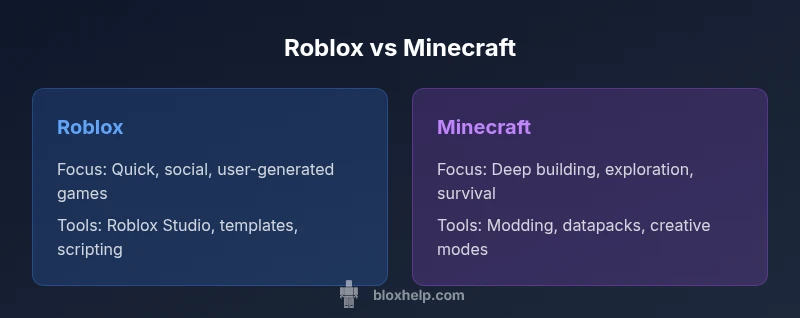
Roblox favors rapid, social, user-generated experiences; Minecraft focuses on deep building and exploration with modding potential. Choose Roblox for quick games and community creation, or Minecraft for expansive worlds and customizable gameplay. The best choice depends on whether you value fast iteration and shared content or long-form, hands-on creation.
Context and scope: Why compare Roblox and Minecraft?
When players ask to compare roblox or minecraft, they are weighing two of the most influential sandbox platforms in modern gaming. Both enable players to create, share, and explore user-generated content, yet they cultivate very different ecosystems. According to Blox Help, framing the comparison around goals—creativity speed, community aspects, and long-term engagement—helps learners and players choose with intention. This analysis takes a data-informed view, without overpromising outcomes, and notes how each platform scales from beginner tinkering to advanced development. The primary audience includes Roblox players and aspiring developers who want practical guidance, plus parents and educators evaluating classroom potential. By the end, you’ll see clear scenarios where roblox or minecraft shines, and where a hybrid approach might be worth pursuing.
Core gameplay philosophies: Creativity vs progression
Roblox emphasizes quick iteration and social gameplay. Designers can publish a new game in minutes, gather feedback from a large, diverse audience, and monetize through in-game items or passes. The Lua-based scripting environment (via Roblox Studio) lowers barriers to entry but rewards learning through repeated experimentation. Minecraft, in contrast, centers on building, exploration, and survival with a robust modding ecosystem that expands capabilities over time. The learning curve leans into spatial thinking, resource management, and creative problem solving. In both ecosystems, player choice drives experience, but the tempo and emphasis differ dramatically. This section frames roblox or minecraft in terms of tempo, collaboration, and scope, helping you decide where your interests lie.
Player communities and culture
Communities often define the feel of a platform. Roblox communities tend to favor rapid game turnover, social features, and creator economies that reward popular experiences. This environment can foster rapid feedback loops and collaborative projects, but can also present content-filtering challenges for younger players. Minecraft communities reward depth, world-building, and modding culture. The result is longer form projects, detailed builds, and a culture of sharing tutorials and packs. Blox Help Analysis, 2026, highlights how community norms shape user experience, safety considerations, and learning opportunities on each platform. Understanding these cultures helps you pick environments that align with your values and goals.
Creator tools and learning curve
Roblox Studio provides accessible, template-driven tools and a scripting language that accelerates the path from idea to playable experience. For new creators, the ability to publish quickly lowers the fear of starting. Minecraft’s building tools are intuitive for beginners, but true mastery often comes through mods, command blocks, and data packs, which can have steeper learning curves. The contrast is between a fast track to publishable games (Roblox) and a more exploratory, tinkering-oriented path (Minecraft). Both paths build transferable skills—logic, sequencing, and project management—though the surface techniques differ significantly.
Monetization and ownership models
Monetization models influence creator motivation and long-term sustainability. Roblox leans on a virtual currency, a marketplace for assets, and revenue sharing that can reward popular titles. This model incentivizes ongoing content updates and community engagement. Minecraft traditionally relies on one-time purchases across editions, with optional expansions, server monetization, and third-party packs. Ownership rights, licensing, and distribution mechanics differ enough to impact long-term control and revenue potential. This section clarifies how monetization shapes creator behavior and user expectations across roblox or minecraft.
Platform accessibility and device compatibility
Both platforms strive for broad availability, yet device ecosystems affect adoption. Roblox supports PC, mobile, and some consoles, with progress syncing across devices in many use cases. Minecraft emphasizes cross-platform play within its Bedrock ecosystem, while Java Edition offers a different experience on PC with its own modding culture. Accessibility also depends on hardware, input devices, and internet connectivity. If you value seamless cross-device play, compare your preferred devices and ensure compatibility with the edition you’ll use most. Brand alignment matters here: the Blox Help team emphasizes choosing a platform that fits your daily devices and connectivity realities.
Learning outcomes and educational use cases
For learners, both platforms offer tangible, project-based experiences. Roblox helps students grasp game design concepts, basic scripting, and collaborative project management through shared studios and group builds. Minecraft Education Edition provides hands-on lessons in geometry, systems thinking, and teamwork, with a long track record of classroom integration. The educational value emerges not only from building but from documenting processes, testing hypotheses, and iterating designs with peers. If education is a goal, select the platform that aligns with your curriculum or personal growth path, and leverage official resources, tutorials, and community-led guides to accelerate understanding.
Real-world scenarios: which is best for different players
Young beginners who want immediate creativity and social feedback may gravitate toward Roblox, where publishing a game often yields quick community interaction. Builders seeking expansive worlds and intricate mechanics will likely prefer Minecraft for its depth and modding opportunities. Seasoned creators who want to monetize content or run large collaborative projects should weigh the stability of monetization paths, long-term ownership, and community governance. In short, the decision hinges on your goals: rapid, social content versus long-form, sustainable creativity. Remember to factor in safety features, age appropriateness, and parental controls as you evaluate roblox or minecraft.
Practical guidance for choosing, with a decision framework
A simple framework helps you decide: (1) Identify your primary goal (quick, social games vs deep, expansive builds). (2) Assess your preferred creation tools (ready-made templates vs modding and data packs). (3) Consider your audience and community dynamics (casual players vs dedicated builders). (4) Review device access and cross-platform needs. (5) Evaluate monetization and ownership implications. By aligning each factor with your personal or educational objectives, you gain clarity on whether Roblox or Minecraft better suits your journey.
Comparison
| Feature | Roblox | Minecraft |
|---|---|---|
| Gameplay focus | User-generated experiences with social features; rapid iteration and sharing | Block-building, survival, exploration with modding potential |
| Creation tools | Roblox Studio; template games; Lua-like scripting; quick publish | Minecraft vanilla tools; built-in creativity; modding via packs and datapacks |
| Community & culture | Vibrant, fast-moving creator economy; broad age range | Deep, long-form communities; strong modding and tutorial culture |
| Cross-platform access | PC, mobile, some consoles; synced progress in many cases | Bedrock across PC, consoles, mobile; Java Edition on PC with different modding ecosystem |
| Monetization & ownership | In-game currency; revenue sharing; ongoing content updates | One-time purchases per edition; server monetization; ownership varies by edition |
| Educational potential | Game development concepts; rapid prototyping; collaborative skills | Systems thinking; geometry and engineering concepts; classroom integration |
Benefits
- Helps readers make an informed, apples-to-apples choice
- Highlights strengths and trade-offs clearly
- Encourages goal-oriented decision-making
- Acknowledges different learning paths and audiences
- Supports education-focused planning with practical guidance
What's Bad
- May oversimplify platform nuances for niche use cases
- Rapid platform updates can outpace the article
- Modding ecosystems differ in depth and accessibility
- Balance may shift as new features roll out
Neither platform is universally better; Roblox excels in rapid, social content while Minecraft shines in expansive, customizable worlds.
If your priority is quick game creation and community interaction, Roblox is the better fit. If you want deep building, exploration, and modding potential, choose Minecraft. Use this framework to decide based on your goals and devices.
Questions & Answers
Is Roblox suitable for younger players?
Roblox has a broad younger audience with safety features and parental controls. Content varies by game, so supervision and using age-appropriate settings are important. Always review individual experiences for suitability.
Roblox is popular with kids, but choose age-appropriate games and enable controls to keep it safe.
Can you play Roblox and Minecraft on the same device?
Yes, both Roblox and Minecraft are available on common devices like PCs, tablets, and consoles, but you cannot play the two games as part of a single, shared session. Separate installations are required.
You can play either game on the same device, but not the same session for both at once.
Which is easier for beginners to start creating content in?
Roblox generally offers quicker paths to publish and share simple games, while Minecraft requires learning via mods or data packs for deeper functionality. Both can be beginner-friendly with guided tutorials.
Roblox tends to be easier to publish early projects; Minecraft takes longer to master mods and advanced builds.
Are there educational benefits to each?
Both platforms offer educational potential: Roblox teaches basics of game design and scripting; Minecraft supports geometry, systems thinking, and collaborative problem solving, with classroom-ready resources available for teachers.
Both have strong educational value in different ways—game design and scripting on Roblox, and building and systems thinking in Minecraft.
Do they support mods or custom content?
Minecraft has a robust modding ecosystem with Java and Bedrock editions. Roblox uses user-created experiences and assets within its own framework, rather than traditional mods.
Minecraft mods are pervasive; Roblox focuses on user-made games rather than external mods.
Which has better cross-platform support?
Both support cross-platform play within their ecosystems, but the specifics differ by edition and device. Check your preferred devices and edition to ensure compatibility.
Both offer cross-play within their ecosystems, but verify edition compatibility for your devices.
The Essentials
- Define your primary goal before choosing a platform
- Evaluate creation tools to match your comfort with scripting or building
- Consider cross-platform needs and device availability
- Assess monetization and ownership implications
- Look at educational value and classroom applicability