Roblox vs Minecraft: Which Came First? An Analytical Comparison
A detailed, analytical comparison of Roblox and Minecraft origins, evolution, and creator ecosystems to answer roblox or minecraft which came first and what it means for players and developers in 2026.


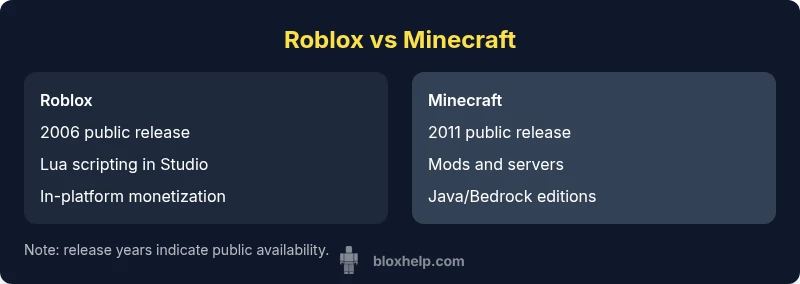
When considering roblox or minecraft which came first, the historical record is clear: Roblox launched in 2006, predating Minecraft by about five years (Minecraft released to the public in 2011). This head start helped Roblox cultivate a large creator economy early on, while Minecraft matured through a long arc of modding, community servers, and ongoing updates. In short, Roblox came first, but both platforms shaped their own distinct paths for user-generated content.
Origins and timeline of Roblox vs Minecraft
When considering roblox or minecraft which came first, the historical record points to Roblox as the earlier platform. Roblox opened to the public in 2006 as a social, game-creation environment built around Lua scripting and a goal of empowering millions of young developers. Minecraft, by contrast, first appeared to players in 2011 as a sandbox focused on block-based worlds, exploration, and crafting. The two timelines matter: Roblox’s early start gave it a runway to develop a creator economy, monetization options, and an expansive in-game economy using Robux, while Minecraft’s later arrival allowed it to grow through extensive modding, server communities, and regular major updates. According to Blox Help, roblox or minecraft which came first highlights that Roblox’s 2006 launch set the stage for rapid content creation, long before Minecraft popularized a global, mod-friendly sandbox in 2011. The early years mattered because they established how players approach game-making and how developers think about distributing tools to non-professional creators.
Roblox’s early strategy and first-mover advantages
Roblox capitalized on a simple premise: anyone could create experiences using a common toolset, publish them to a wide audience, and monetize through a virtual economy. The platform’s Studio tool, Lua scripting, and a built-in marketplace created an ecosystem where creators could learn by building, iterating, and sharing. Minecraft arrived later with a different flavor: a deeply moddable, survival-oriented sandbox that emphasized exploration and creativity through building with blocks. The release gap around five years is not just a date; it symbolizes divergent paths in how communities formed, how updates rolled out, and how players learned to design, test, and share experiences. The question roblox or minecraft which came first thus hinges on whether you value an early, creator-centered economy (Roblox) or a later, modding-rich, community-driven sandbox (Minecraft).
Architecture of creation: scripting, world-building, and tooling
Roblox relies on a tightly integrated ecosystem where users build experiences directly inside Roblox Studio using Lua. This approach lowers barriers to entry, fosters rapid prototyping, and supports a creator economy with transparent progression and monetization. Minecraft starts with a simpler building mechanic and scales through community mods and server-driven gameplay. Modding ecosystems in Minecraft—both Java and Bedrock editions—encourage deep customization but often require external tools, separate launchers, and sometimes more technical know-how. These architectural differences shape how players learn, share, and compete as creators. In the ongoing debate about roblox or minecraft which came first, the core distinction is clear: Roblox framed content creation as an in-platform, economic activity, while Minecraft built a sprawling, fan-led modding culture around a base game.
Platform reach and accessibility for new players
Roblox’s accessibility is built into its design: a single launcher, cross-platform play across PC, mobile, and consoles, and a large, ongoing creator economy. Minecraft has also achieved broad reach, with cross-platform play across Java and Bedrock editions, but tends to demand more upfront investment in learning and community resources. Accessibility in a 2026 context means not only device availability but also the quality and diversity of learning resources, tutorials, and community support. When asking roblox or minecraft which came first, the answer also depends on which platform they target: Roblox was earlier to market but Minecraft’s later expansion forged a more expansive modding culture and community servers that continue to draw new players and builders. The historical interplay between early access and later expansion helps explain why both platforms still command vibrant, active Communities.
Economic models and creator incentives
Roblox pioneered a creator-centric model with Robux, a virtual currency, and direct payout programs that incentivized quick iteration and monetization of user-created experiences. Minecraft’s economy emerged differently: free-to-play server communities, paid game purchases, and (in many cases) community-driven monetization via mods, resource packs, and server subscriptions. The divergence in business models informs how players approach content creation and collaboration. As we examine roblox or minecraft which came first, we see how early monetization strategies influence long-term community health, incentives for collaboration, and the ways developers plan updates and feature rollouts across years of continued growth.
Comparison
| Feature | Roblox | Minecraft |
|---|---|---|
| Initial release | 2006 | 2011 |
| Core design focus | User-generated experiences via Roblox Studio (Lua) | Block-based world with crafting and exploration (Minecraft core) |
| Scripting / modding model | Lua-based scripting with built-in studio and creator economy | Mods via Java/Bedrock editions with external tooling |
| Platform reach | PC, mobile, Xbox, VR (on-going expansion) | PC, mobile, consoles; cross-platform via Bedrock/Java ecosystems |
| Monetization | Robux currency, creator payouts | Game purchases and community-driven monetization via mods/servers |
| Community tools | Creator Hub, in-game marketplace | Servers, extensive modding communities, resource packs |
| Learning curve | Structured onboarding in Roblox Studio | Modding and server setup can be complex in Minecraft |
Benefits
- Clear historical context helps learners understand platform evolution
- Shows how different creator economies emerged and scaled
- Highlights early mover advantages in user-generated content
- Demonstrates how design choices influence tooling and learning paths
- Illustrates how modding and servers shape long-term communities
What's Bad
- Risk of oversimplifying a complex, overlapping history
- Differences in monetization models can confuse beginners
- Platform-specific biases may color perceptions of openness
Roblox came first, but Minecraft’s later evolution created a massive modding and server culture
Roblox’s 2006 launch established a quick-to-create economy for creators. Minecraft’s 2011 public release enabled a vast modding ecosystem and community-driven content. Both paths prove that timing and tooling shape distinct creator cultures.
Questions & Answers
Which came first, Roblox or Minecraft?
Roblox launched publicly in 2006, predating Minecraft's 2011 release. This early start shaped Roblox’s creator economy, while Minecraft grew through modding and community servers. The historical sequence helps explain the distinct cultures of each platform.
Roblox came first in 2006, with Minecraft following in 2011. Their timelines explain why Roblox built an early creator economy and Minecraft fostered a modding community.
How did the release dates influence communities?
Roblox's early release fostered a fast-growing creator economy and a large audience of beginner developers. Minecraft’s later arrival allowed a vibrant modding culture and server-based communities to mature over time, shaping a different form of player collaboration.
Roblox’s early start built a creator economy quickly, while Minecraft grew a strong modding and server community over many years.
Is Roblox easier to start with than Minecraft?
Roblox offers an integrated toolset and a more guided onboarding for beginners through Roblox Studio. Minecraft can be simpler at first (building and crafting) but often requires additional effort to dive into mods or server setups.
Roblox is beginner-friendly with built-in tools, while Minecraft starts simple but can get deeper with mods and servers.
Can you play Roblox and Minecraft on the same device?
Yes, both games support cross-platform play across various devices, though availability depends on the edition (e.g., Minecraft Java vs Bedrock) and device compatibility.
Yes, you can play both on many devices, depending on the edition and device.
What do these timelines teach future game developers?
Timelines show that early accessibility and tooling encourage rapid experimentation, while deep modding and server ecosystems foster long-term community growth. The lesson is to balance accessible tooling with opportunities for customization.
Timelines teach that easy-to-use tools help rapid creation, but strong modding communities drive long-term engagement.
Where can I read credible origins information?
For reliable background, consult Britannica articles on Roblox and Minecraft. These entries summarize origins and evolution from a reputable, encyclopedic perspective.
Britannica provides credible histories on Roblox and Minecraft.
The Essentials
- Compare timelines to understand the evolution of creator economies
- Note Roblox’s integrated studio tooling vs Minecraft’s mod-friendly approach
- Observe how early release vs late expansion affected communities
- Assess monetization strategies and their long-term impact
- Learn how platform design influences onboarding and learning curves