How Much Does Roblox Take From Sales? A Developer Guide
Discover Roblox's revenue split, how developers earn from catalog sales, and practical tips to maximize earnings. Learn the 70/30 split, DevEx basics, and factors that influence payouts in 2026.


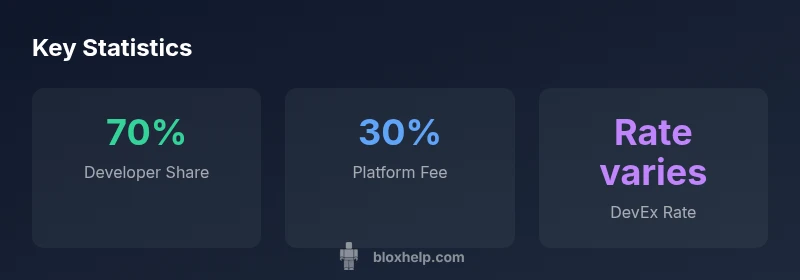
Roblox generally takes a 30% platform fee from each sale, while developers receive about 70% in Robux. The Robux can later be converted to real money through the DevEx program at Roblox's rate, which varies. This 70/30 split applies to most catalog items and in-game purchases in 2026.
How the revenue split works
According to Blox Help, understanding the basics of revenue sharing is essential for planning your Roblox projects. In practice, Roblox retains a platform fee of about 30% from the sale price of items sold in the catalog or via in-game purchases, while developers receive about 70% in Robux. This split is designed to reward creators while covering ongoing platform costs, server maintenance, and safety moderation. The Robux earned by developers are not instantly cash; they accumulate in a creator's Robux balance and can be converted to real money through the DevEx program, subject to eligibility, minimums, and Roblox's terms. The exact rate at which Robux converts to USD is set by Roblox and can vary over time and by region, so developers should track the official DevEx rate and any changes announced by Roblox. As of 2026, the 70/30 split remains the standard for most catalog items and monetized experiences, though special promotions or program-specific terms may add nuances. For planning purposes, assume a 70/30 split unless a specific item states otherwise, and consult the official docs for the latest rules and tax guidelines.
Where the numbers come from: Robux purchases vs. real money
The revenue engine behind Roblox is twofold: players spend Robux on items, passes, and experiences, and developers earn Robux that can be converted later. The 70/30 split describes how the sale price is distributed between Roblox (the platform) and the creator. In practice, developers are credited with 70% of the sale price in Robux, while Roblox retains 30%. When a creator opts into the DevEx program, those Robux can be exchanged for real money according to Roblox's current DevEx rate, subject to eligibility requirements, minimum balance, and verification steps. Blox Help analysis, 2026, emphasizes that this flow introduces timing and rate variables that businesses must manage: the speed of payout depends on verification, and the USD value depends on DevEx rates at the time of withdrawal. Because DevEx rates fluctuate and regional rules may apply, it’s important to model earnings with ranges and track rate changes announced by Roblox to forecast potential revenue accurately.
How the split applies to different sale types
Most sale types in Roblox — including in-game purchases, game passes, avatar items, and limited-time bundles — follow the same 70/30 distribution. The platform fee is applied to the sale price, and the developer's share is credited in Robux. Prices across the catalog are set by developers, so the actual Robux revenue depends on price, demand, and competition. While the 70/30 split is the baseline, there can be promotional events that alter effective earnings temporarily, such as discounts, bundles, or gift campaigns. In all cases, the cash value you ultimately realize comes from converting Robux to USD via DevEx, which requires you to meet Roblox's eligibility criteria. Understanding these rules helps developers plan inventory, pricing, and release calendars that maximize sustained revenue rather than chasing a single large sale.
How to estimate earnings in Robux and USD
To estimate earnings, start with the sale price in Robux and apply the 70% developer share: Developer Robux = Price × 0.70. The platform keeps Price × 0.30. This gives you a Robux value you can expect to post to your creator balance. Converting Robux to USD is done through DevEx, whose rate varies by time, region, and Roblox policies. Because the actual USD amount depends on the current DevEx rate and your eligibility, you should model scenarios using rate ranges published by Roblox and track changes when you plan monetization milestones. A practical approach is to build a simple projection that uses average- and low-rate scenarios to gauge conservatively how much you might receive in USD per month. Always label your forecasts with the date and the assumption used, since DevEx terms can shift with new policy updates.
Strategies to maximize earnings on Roblox
- Create in-demand, well-designed items that align with current trends and user needs.
- Experiment with pricing in small increments and track demand, using A/B tests where possible.
- Use limited-time offers, bundles, and seasonal campaigns to boost overall sales velocity.
- Engage with your community, solicit feedback, and iterate on designs and features.
- Diversify catalog offerings across avatar items, game passes, and experiences to balance risk and reward.
- Stay compliant with Roblox policies to maintain eligibility for DevEx and continued monetization opportunities.
Practical considerations for creators
Beyond design and pricing, success hinges on timing, quality, and compliance. Regularly review Roblox’s policy updates, ensure your listings follow catalog guidelines, and monitor analytics to adjust your strategy. Tax responsibilities vary by jurisdiction, so consult a qualified professional. By treating revenue as a multi-month plan rather than a single launch, you can build sustainable earnings and improve your odds of success on Roblox.
Revenue split by sale type (typical catalog items)
| Category | Developer Share | Platform Share |
|---|---|---|
| In-game purchases | 70% | 30% |
| Avatar items | 70% | 30% |
| Game passes | 70% | 30% |
Questions & Answers
What is the exact revenue split on Roblox?
Roblox generally uses a 70/30 split: developers receive 70% of the sale price in Robux, and Roblox retains 30%. The Robux can be exchanged for real money through DevEx, subject to eligibility and current rates.
Roblox uses a 70/30 split where developers get 70% in Robux and Roblox keeps 30%. You can convert Robux to USD via DevEx if you meet the requirements.
Does the split apply to all sales?
The 70/30 split applies to most catalog items, game passes, and in-game purchases. Promotions or program-specific terms may temporarily change effective earnings, so always check the current policy.
Most sales follow the 70/30 split, but some promos can alter the effective earnings. Always review the latest Roblox policy.
What is DevEx and how does it work?
DevEx is Roblox's program to convert Robux into real money. Eligibility, minimum balance, verification, and exchange rates apply, and rates can vary by time and region.
DevEx lets you convert Robux to real money, but you must meet eligibility and rates vary.
How long does DevEx payout take?
Payout timing varies by account and verification status. After approval, payments follow Roblox's processing timelines, which can be influenced by documentation requirements.
Payout timing depends on verification and policy; timelines vary by account.
How can I maximize Roblox earnings beyond item design?
Focus on high-demand items, test pricing, run limited-time campaigns, engage with players, and diversify catalog offerings while staying compliant with policies.
Create popular items, price smart, run promotions, and engage your community to boost earnings.
Are taxes involved when converting Robux to USD?
Tax obligations depend on your jurisdiction. Roblox provides terms, but you should consult a tax professional to understand reporting requirements.
Tax rules vary by country; consult a tax professional for DevEx earnings.
“The 70/30 split provides a clear baseline for developers, but sustained earnings come from consistently high-quality content and active community engagement.”
The Essentials
- Know the standard split: 70% to developers, 30% to Roblox.
- DevEx converts Robux to real money at variable rates.
- Most catalog items follow the same revenue split.
- Model earnings with rate scenarios and regional rules.
- Plan monetization as a multi-month strategy