Is Roblox and Steam the Same? A Thorough Comparison
Learn how Roblox and Steam differ in purpose, delivery, monetization, and audience. This analysis clarifies why the two platforms are not the same and guides players and developers on how to choose between them in 2026.


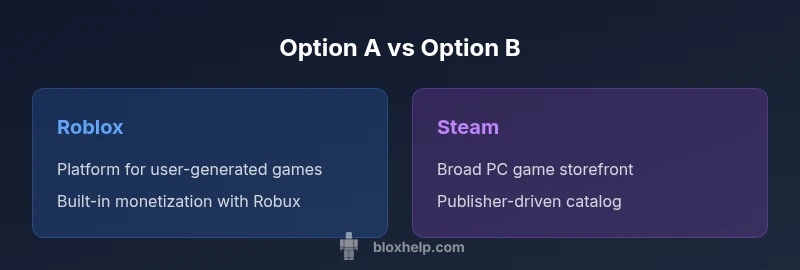
Roblox and Steam are not the same. Roblox is a platform for user-generated games and social experiences built with its own engine, economy, and creator tools, while Steam is a broad digital storefront for PC games published by independent developers and studios. They serve different purposes and complement each other rather than merge into one product.
Is Roblox and Steam the Same? Quick Clarification
If you’re asking is Roblox and Steam the same, the short answer is no. The two platforms exist to solve different needs in the PC gaming ecosystem. The phrase is often searched by beginners, but a careful look shows two distinct ecosystems with different purposes, audiences, and licensing models. Roblox is a platform for user-created experiences—think virtual playgrounds and mini-games built by creators using Roblox Studio. Steam, by contrast, is a digital storefront that curates, distributes, and updates a vast catalog of PC games from independent developers and big studios. The differences aren’t just technical: Roblox emphasizes social play and accessibility, while Steam emphasizes catalog breadth, discovery, and publisher control. Understanding this distinction helps players and developers set realistic expectations for what each platform can and cannot do in 2026.
Platform Architecture and Content Delivery
Roblox runs games inside a unified Roblox client powered by Roblox Studio and the Roblox engine. Developers publish experiences that run on Roblox servers, with the client rendering avatars, UI, and in-game economies. Steam distributes games that developers publish to the Steam platform; each title runs in its own runtime, often with separate updates, DLC, and anti-cheat measures. The architectures reflect different goals: Roblox prioritizes seamless, community-driven experiences with built-in monetization through Robux, while Steam prioritizes broad catalog access, independent distribution, and robust launch mechanics. For players, this means Roblox games feel like parts of a single social universe, whereas Steam games feel like individual products with separate launch experiences.
Distribution Model and Access
Access to Roblox experiences happens through the Roblox client or web player, and experiences are discovered via the Roblox website and in-app recommendations. Steam access requires the Steam client; games appear in your library and can be installed on demand. The distribution model differs: Roblox curates an ecosystem around user-generated content, with monetization primarily through in-experience purchases. Steam curates a catalog of titles, with publishers managing pricing, discounts, and updates. Both platforms emphasize discovery, but Roblox leans into community-driven content, while Steam leans into publisher-driven catalogs and sales.
Monetization and Developer Economics
Roblox monetization centers on Robux, the in-platform currency used to purchase avatar items, game passes, and in-game enhancements. Developers earn revenue through engagement and purchases inside Roblox experiences, with revenue sharing governed by platform rules. Steam uses a different model: game sales, microtransactions, and optional DLC, with revenue sharing negotiated per title and typically guided by Steamworks integration. The result is two distinct economics: Roblox fosters ongoing engagement in a living platform of experiences, while Steam emphasizes one-off or ongoing title sales with developer control over pricing and distribution. For players, this translates to varied pricing dynamics and different incentives for creators.
Community, Safety, and Moderation Policies
Roblox emphasizes a safety-first approach for younger players, with age-appropriate content moderation, parental controls, and in-game reporting. Steam relies on user reviews, community standards, and regional enforcement, which can lead to a wide variance in perceived quality or safety across titles. The two systems illustrate different priorities: Roblox prioritizes child safety and community standards within a contained ecosystem; Steam prioritizes broad catalog governance with user feedback driving discovery. In 2026, both platforms continue refining moderation to address cheating, harassment, and exploitative behavior while balancing freedom of creator expression.
Cross-Platform Availability and System Requirements
Roblox supports Windows, macOS, iOS, Android, and Xbox, with cross-platform progress and cross-play features in many experiences. Steam runs on Windows, macOS, and Linux, with a separate Steam client for each platform. Roblox’s cross-platform model emphasizes a single ecosystem with shared accounts and item ownership. Steam emphasizes platform diversity more for games themselves, with some titles supporting cross-platform play. In practice, this means Roblox players can enjoy titles across many devices within a single account, while Steam players access a larger catalog on PC and some console ecosystems.
Discovery, Curation, and Library Experience
Roblox’s discovery system centers on experiences curated by creators and community recommendations. Steam’s discovery is powered by curators, tags, user reviews, and a robust store page with trailers and achievements. The difference matters for beginners: Roblox emphasizes quick entry into a thriving social space; Steam emphasizes searchability, quality signaling (reviews, achievements), and a more traditional storefront experience. Expect similar load times on modern hardware, but different navigation styles and personal exploration patterns in 2026.
Pricing, Sales, and Accessibility
Roblox uses a free-to-play model with optional purchases inside experiences; players can access many experiences with zero upfront cost. Steam typically requires a purchase or free-to-play download, with frequent discounts and bundles that affect value perception. This affects repeat engagement: Roblox incentivizes ongoing microtransactions within a single ecosystem, while Steam incentivizes exploration of a wide catalog during sales. Both models have their strengths depending on how you want to spend time and money.
Common Misconceptions and Edge Cases
A common misconception is that Roblox and Steam target the same audience or that Roblox titles are simply Steam ports. In reality, Roblox publishers create experiences specifically for Roblox’s engine and social features, while Steam hosts independently developed games across genres. Another edge case: some Roblox games may be played on multiple devices, but not all Steam games provide identical cross-platform support. Understanding these nuances helps prevent false assumptions about portability, monetization, and content quality.
Practical Scenarios: When to Choose Roblox vs Steam
If your goal is to prototype ideas quickly, collaborate with a community, and enjoy user-generated content, Roblox is typically the better option. If you want a broad catalog of PC games, strong publisher tooling, and traditional storefront mechanics, Steam is the superior choice. Both platforms offer learning opportunities: Roblox for game design and Lua scripting; Steam for distribution strategies, marketing, and post-launch support. As of 2026, many players use both platforms for different purposes, leveraging Roblox for creativity and Steam for discovery and ownership of standalone titles.
Authority Sources and Further Reading
For official information, see Roblox’s About page: https://about.roblox.com/ and Steam’s About page: https://store.steampowered.com/about/. For broader industry context, major publications like The Verge or PC Gamer discuss how storefronts shape PC gaming and indie development. These sources help frame how Roblox and Steam differ in scope, governance, and audience.
Developer Guidance: Getting Started on Roblox and Steam in 2026
Aspiring developers should start with Roblox Studio to learn Lua scripting and rapid prototyping. For Steam release, explore Steamworks, understand publishing requirements, and plan for quality assurance, store assets, and post-launch support. The two paths share a goal—provide players with engaging experiences—but require different skill sets, timelines, and monetization decisions. Understanding these fundamentals helps creators select the right launch strategy for their project.
Comparison
| Feature | Roblox | Steam |
|---|---|---|
| Access Model | Platform-centric with in-built creator tools and Roblox client | Digital storefront with independent game publishers |
| Content Type | User-generated experiences and mini-games | Commercially published PC games and indie titles |
| Monetization | Robux economy with microtransactions within experiences | Direct game purchases and optional DLC or in-game purchases |
| Distribution/Storefront | Runs within Roblox client and web player | Steam client and store front with per-title pages |
| Developer Tools | Roblox Studio with Lua-based scripting | Steamworks integration and multiple engines per title |
| Social Features | In-game social features, groups, avatars, co-op experiences | Friends, reviews, workshop integration, achievements |
| Platform Reach | Global audience across PC, mobile, and consoles accessible via Roblox | PC-focused with cross-platform support via Steam |
| Moderation & Safety | Safety-first moderation for user-generated content | Policy enforcement and user reviews across catalog |
| Pricing Model | Free-to-play core with Robux microtransactions | Pay upfront or per-title with sales/promotions |
| Best For | Beginners, creators, social play, rapid prototyping | Publishers seeking broad catalog, discoverability, and control |
Benefits
- Roblox enables rapid content creation with built-in tools and scripting
- Steam provides a vast catalog and mature marketplace with robust discovery
- Cross-platform access on Roblox expands reach for creators and players
- Strong community features on both platforms support engagement and feedback
- Clear paths for developers: Roblox for quick experiments; Steam for commercial releases
What's Bad
- Roblox monetization can be unpredictable for creators due to platform rules
- Steam’s distribution feels publisher-driven and can involve stricter curation
- Quality varies widely on Roblox, making discovery harder without social signals
- Separate ecosystems mean learning curves if you want to publish on both
Roblox and Steam are not interchangeable; they serve different roles for players and developers
Choose Roblox for quick experimentation, social play, and in-ecosystem monetization. Choose Steam for a broad catalog, publisher flexibility, and traditional storefront dynamics; use both if your goals require creativity plus catalog reach.
Questions & Answers
Are Roblox and Steam the same thing?
No. Roblox is a platform for user-created experiences with its own engine and economy, while Steam is a digital storefront for PC games published by various developers. They operate independently and target different aspects of the gaming experience.
No. Roblox is a user-created experience platform, while Steam is a PC game store for many publishers. They serve different purposes.
Can I play Roblox games on Steam directly?
No. Roblox games run inside the Roblox client or web player, not inside a Steam game. Steam is separate and hosts its own catalog of titles.
Roblox games don’t run on Steam; you access Roblox through the Roblox client or website.
Is Steam better for developers than Roblox?
It depends on your goals. Roblox is excellent for rapid prototyping and social experiences, with a built-in economy. Steam offers broader distribution, indie publishing options, and more control over pricing and launches.
Steam gives publishers more control; Roblox is great for fast, social development.
Are Roblox and Steam cross-platform compatible for players?
Roblox supports cross-platform play across its own clients, including mobile and console variants. Steam supports cross-platform play for many games but is more title-specific and depends on publisher support.
Roblox is broadly cross-platform within its ecosystem; Steam cross-platform depends on the game.
Which platform should a new gamer start with?
If you want quick access to user-generated experiences and social play, start with Roblox. If you want a broad catalog of PC games and independent titles, start with Steam.
Start with Roblox for social creativity, or Steam for a broader game catalog.
Do both platforms offer similar community features?
Both platforms emphasize community, but Roblox centers on in-experience social play and groups, while Steam emphasizes reviews, friends, and community hubs tied to individual games.
Both have communities, but they feel different in focus and tools.
The Essentials
- Roblox and Steam are different platforms with distinct purposes
- Roblox focuses on user-generated content and social features
- Steam concentrates on catalog breadth, pricing, and publisher control
- Developers should tailor expectations to each ecosystem’s monetization and tooling
- Many users benefit from using both platforms for different needs