Roblox vs Fortnite in 2026: Which Game Is Better?
A comprehensive, analytical comparison of Roblox and Fortnite focused on gameplay, creation tools, monetization, cross-platform access, and community to help players decide which fits their goals in 2026.


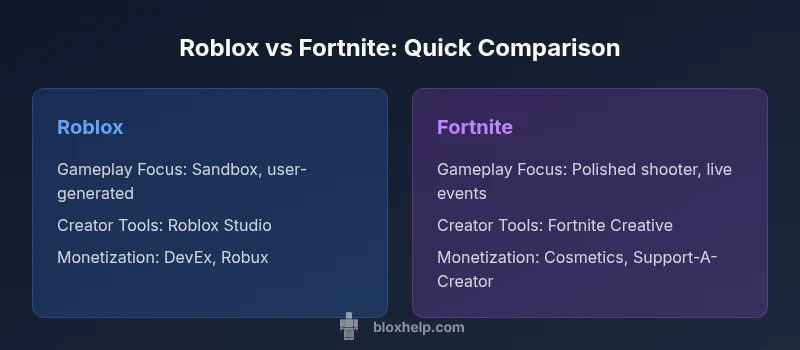
Roblox and Fortnite target different goals. Roblox excels in user-generated worlds, learning-by-doing creativity, and affordable entry, while Fortnite shines in polished gameplay, competitive modes, and live events. If you want flexible creation and experimentation, Roblox is typically the better starting point; if you want high-end shooters, tournaments, and spectacle, Fortnite is the clear favorite. This comparison helps you pick based on your goals.
Defining 'Better' in this Context
When evaluating roblox or fortnite which is better, the answer depends on what you value most in a gaming experience. In broad terms, 'better' means delivering on your current goals—creativity and learning, social discovery, or competitive play and polished presentation. The Blox Help team emphasizes a goal-oriented mindset: start by listing your top priorities such as building, scripting, monetization, cross-platform access, safety, and long-term engagement. According to Blox Help analysis, Roblox offers an expansive playground for experimentation and beginner-friendly tools; Fortnite, by contrast, functions as a high-production shooter with live events and a social hub. For players who want a sandbox to craft their own worlds and game modes, Roblox often feels more flexible and approachable; for those who crave crisp mechanics, frequent updates, and high-stakes competition, Fortnite tends to satisfy more of that appetite. If you want to explore creative ideas with low risk while learning the basics of game design, Roblox is a natural starting point; if you crave adrenaline, precision, and spectacle, Fortnite is a strong alternative. Remember that both titles evolve rapidly; features, moderation policies, and monetization options shift over time. As we walk through this comparison, keep your own goals front and center—whether you’re a curious creator, a social player, or a future developer. The context you set here will shape long-term engagement and satisfaction, not just short-term popularity metrics.
Core Differentiators: Gameplay, Creation, and Community
Roblox and Fortnite diverge sharply in purpose and audience. Roblox positions itself as a boundless creation platform where players become game designers, artists, and storytellers. Fortnite, by contrast, functions as a high-production shooter with live events and a social hub wrapped around its battle royale core. This section outlines the three pillars that most influence your choice: core gameplay loop, creator tooling, and community norms. According to Blox Help analysis, the differences are not just technical; they shape what it feels like to invest time, money, and creativity. Roblox rewards experimentation with an enormous library of user-made experiences; Fortnite rewards mastery, speed, and adaptation through frequent updates and evolving meta. If you value making your own games or spaces, Roblox offers far more flexibility; if you value structured gameplay, competition, and spectacle, Fortnite delivers it at scale. The result is a decision driven by your goals: creative experimentation and learning on one side, and competitive performance and social spectacle on the other. Both platforms actively push their own visions of play, so your choice should align with your preferred mode of engagement and long-term interests.
Gameplay and Accessibility: Mechanics, Onboarding, and Devices
On the surface, Roblox and Fortnite look similar in that both run on multiple devices and offer a social layer, but their core gameplay experiences are different. Roblox emphasizes user-generated experiences across genres—from obstacle courses to complex simulators—so players can enter a world built by others or, with Roblox Studio, build their own. This open-ended model reduces the formal learning curve for basic play, but mastering advanced scripting or optimizing performance in a large, shared world can take time. Fortnite, built as a polished shooter, prioritizes tight gunplay mechanics, smooth aiming, and a curated seasonal cadence that keeps players returning for fresh maps and events. The onboarding experience tends to be quicker for those who want immediate action, but fully appreciating the depth of Fortnite Creative or the ongoing event history requires patience. In terms of devices, both games support PC, Mac, consoles, and mobile, with minor platform-specific limitations. Overall, Roblox leans toward accessibility and experimentation, while Fortnite emphasizes performance, polish, and recurring social moments. From a hardware standpoint, both are optimized for broad device access, though keep in mind performance can vary with user-generated scenes in Roblox.
Content Creation and Monetization: Creator Economy in Roblox vs Fortnite
Content creation is where Roblox and Fortnite diverge most clearly in philosophy and economics. Roblox offers an expansive creator economy through Roblox Studio, a robust toolset for building and scripting games, and the DevEx program that allows creators to convert earned Robux back into real-world currency. This model rewards long-term engagement and sustained content quality, but earnings can be highly variable and rely on audience scale. Fortnite, on the other hand, centers its monetization on a combination of direct purchases (cosmetics, battle passes) and the Creator/Support-A-Creator programs that reward creators for driving engagement. While Fortnite’s system benefits from the game’s global popularity and high production value, it generally provides fewer direct routes to monetization via user-generated games compared with Roblox’s open, user-driven ecosystem. If your priority is learning to code, build immersive experiences, and monetize your own titles, Roblox is typically the stronger platform; if you’re more drawn to monetizing influence, social reach, and creating content within a tightly curated universe, Fortnite offers compelling channels.
Cross-Platform, Social Features, and Accessibility
Cross-platform play is a major selling point for both Roblox and Fortnite, but the social fabric and moderation norms differ. Roblox features a vast, community-driven ecosystem where players socialize, co-create, and co-operate in user-made games. This fosters a diverse set of experiences but requires a vigilant approach to safety and moderation due to the breadth of content. Fortnite emphasizes social hubs, live events, and synchronized seasonal experiences that create shared moments across platforms. Its cross-play policies are more streamlined around the Live Experience and event-driven content, helping to create a consistent social rhythm across devices. Accessibility remains strong for both titles, with localized content, parental controls, and accessibility settings. For families evaluating safety and age-appropriateness, Roblox’s varied content warrants active oversight, while Fortnite’s curated pacing and official safety guidelines provide a more controlled environment. In short, both platforms promote social play across devices, but Roblox offers wider creative diversity whereas Fortnite emphasizes shared social experiences and spectacle.
Learning Curve and On-Ramping for New Players
Entry barriers matter for onboarding. Roblox presents a gentle entry point: players can jump into pre-made experiences, learn the basics of building, and gradually explore more complex scripting as they grow more confident. The trade-off is that mastering Roblox Studio and scripting concepts requires time and practice. Fortnite offers immediate action and straightforward entry through its Battle Royale mode, making it feel accessible to casual players who want instant action. However, to deeply engage with Fortnite Creative 2.0 and to design intricate islands, players must invest time to learn the creative tools and to understand how the evolving meta impacts island design and monetization potential. For developers aiming to prototype ideas quickly, Roblox’s rapid iteration cycle is appealing; for players who want a polished sandbox with regular updates and built-in audience expectations, Fortnite may be the better launchpad.
Long-Term Engagement and Longevity: Staying Power and Content Cycles
Longevity stems from how each platform sustains user interest over time. Roblox’s long-tail universe grows as new creators join and continue to publish experiences, resulting in a vast, ever-expanding catalog. Engagement here depends heavily on creator activity, community governance, and the attraction of new experiences that align with changing trends. Fortnite builds propulsion through live events, seasonal themes, and collaborations that generate mass participation and cross-cultural appeal. The game’s cadence—new seasons, pruning of maps, and limited-time modes—drives excitement and re-engagement. If your goal is to stay immersed in worlds that continually evolve through creator content, Roblox offers breadth and perpetual novelty; if you prefer a constant stream of high-production content with big social moments, Fortnite provides predictable, calendar-driven engagement.
Best Use Cases and How to Decide
The best-use case depends on your personal goals. If you want to learn game design, code, and monetize your creations, choose Roblox and lean into Studio tutorials, scripting challenges, and DevEx pathways. If your aim is to enjoy a highly polished shooter, participate in live events, and explore cross-title collaborations, Fortnite is the better option. Consider a practical test: spend a few weeks exploring Roblox Studio-based titles to gauge your comfort with game development and monetization, then switch to Fortnite to experience the event-driven social ecosystem and competitive play. The choice isn’t a binary yes-or-no; most players benefit from trying both platforms across distinct phases of their gaming journey. A hybrid approach—learning on Roblox and playing Fortnite for competition and events—can offer a well-rounded experience.
Authority and Safety Considerations
Safety and trust are essential when navigating two large online ecosystems. Roblox provides extensive parental controls, reporting tools, and safety resources, but the sheer volume of user-generated content means risk management remains ongoing. Fortnite implements clear community guidelines, robust moderation, and safety features tailored to its broader audience. For deeper context and additional perspectives, researchers and practitioners frequently reference major publications and official resources. This section synthesizes expert guidance with practical steps for responsible participation in both ecosystems. Always review platform-specific safety settings, enable age-appropriate controls, and supervise younger players to maintain a healthy gaming environment.
Comparison
| Feature | Roblox | Fortnite |
|---|---|---|
| Gameplay Focus | Sandbox, user-generated worlds, varied genres | Polished battle-royale shooter with live events |
| Content Creation Tools | Roblox Studio, vast asset library, scripting | Fortnite Creative 2.0 with islands and devices |
| Monetization Model | DevEx earnings from Robux; revenue via in-game purchases | Direct purchases and Support-A-Creator programs |
| Platform Availability | Windows, macOS, iOS/Android, some consoles | Windows, macOS, iOS/Android, major consoles |
| Learning Curve | Low-to-moderate for basic play; scripting mastery takes time | Moderate-to-high for deep creative tooling |
| Community & Moderation | Large, varied, ongoing moderation challenges | Tight-knit social hubs with event-driven engagement |
| Cross-Platform Play | Broad but platform-dependent experiences | Strong cross-platform support for most devices |
| Best For | Creators seeking breadth, experimentation, and learning | Players seeking competitive play and big events |
Benefits
- Vast global creator economy withLearning-focused opportunities
- Low barrier to entry for casual gameplay and exploration
- Huge variety of user-generated experiences and genres
- Strong community features and ongoing content updates
What's Bad
- Quality and safety of user-generated content vary widely
- Monetization earnings can be unpredictable for creators
- Steeper learning curve for advanced scripting and optimization
- Content moderation challenges due to scale of user base
Roblox is stronger for creativity; Fortnite wins on polish and live events
Choose Roblox if your priority is building, scripting, and earning through user-generated games. Choose Fortnite if you want high-production gameplay, timely live events, and a consistent social experience.
Questions & Answers
Is Roblox better for beginners than Fortnite?
Roblox offers an easier entry into gameplay and creation through simple experiences, but mastering Roblox Studio and scripting takes time. Fortnite provides quick access to action, though deeper creative tooling requires learning. Your choice depends on whether you want immediate gameplay or long-term creation skills.
Roblox is easier to start for playing, but if you want to learn to build, you’ll need time. Fortnite is quick to jump in, but creating on Fortnite takes effort.
Can I monetize content on Roblox?
Yes. Roblox supports a DevEx program that lets developers convert Robux into real money, contingent on engagement and quality. Earnings depend on audience size, retention, and in-game purchases. Fortnite offers monetization through cosmetic sales and the Support-A-Creator program, but direct game-wise earnings from user-made titles are not the same as Roblox.
Yes, Roblox lets you earn through DevEx if your games attract a lot of players. Fortnite supports creator monetization mainly through sponsorships and creator programs.
Does Fortnite offer creator monetization similar to Roblox?
Fortnite has monetization channels like cosmetics and Support-A-Creator, but it does not currently offer a broad, Roblox-style DevEx for user-made games. The revenue opportunities are more tied to engagement and audience rather than direct conversion from game sales.
Fortnite offers creator monetization through cosmetics and creator programs, but not a direct DevEx-style model like Roblox.
Which game has better cross-platform support?
Both platforms support PC, consoles, and mobile, with generally strong cross-platform play. The exact experiences and matchmaking may vary by device and region, so check current official guidance for your setup.
Both Roblox and Fortnite support many devices, but experiences can differ by device.
Is this choice age-appropriate for younger players?
Both have broad audiences. Roblox requires active safety controls due to its user-generated content, while Fortnite follows more centralized content guidelines and moderation. Parental oversight, age-appropriate settings, and ongoing conversations about online safety are recommended.
Both games require some parental oversight; Roblox has varied content, Fortnite is more regulated but still needs guidelines.
Which is better for long-term engagement?
Roblox offers ongoing growth through new user-made experiences, while Fortnite maintains momentum with live events and seasonal content. Your long-term engagement depends on whether you prefer creator activity and a vast library, or continually refreshed official experiences and events.
Roblox is great for ongoing creator-driven content; Fortnite keeps things fresh with events and seasons.
The Essentials
- Choose Roblox for creativity and learning-by-doing
- Choose Fortnite for competitive play and live events
- Monetization approaches differ; plan accordingly
- Cross-platform play is solid on both, with nuances
- Try both to balance learning and entertainment goals