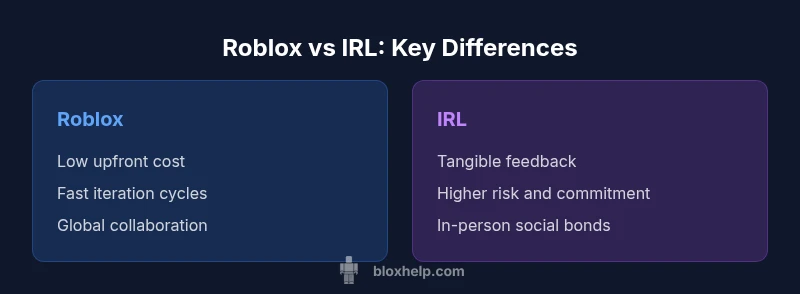
Roblox vs IRL: A Practical Side-by-Side Comparison
An analytical, side-by-side guide comparing Roblox vs IRL, weighing time, cost, safety, and learning potential to help players decide where to invest attention.


Roblox vs IRL boils down to a trade-off between scalable, creative sandbox experiences and real-world constraints. For learners seeking safe, structured experimentation, Roblox offers controlled environments and rapid iteration. For those prioritizing physical activity, hands-on social dynamics, and tangible consequences, IRL remains essential. The best choice depends on goals, resources, and risk tolerance.
Roblox vs IRL: Framing the Debate
For players and learners, Roblox and real life (IRL) represent two complementary domains that shape skills, motivation, and outcomes. The contrast isn't simply digital versus physical; it's about different constraints, affordances, and incentives. From a design perspective, Roblox provides programmable playgrounds with built-in tutorials, event-driven goals, and social spaces, while IRL contexts demand physical presence, tangible consequences, and more complex social cues. According to Blox Help, the value of Roblox in education and personal growth often stems from its structured environment and safe experimentation grounds, which helps beginners prototype ideas quickly while controlling risk. Meanwhile, IRL experiences cultivate resilience, physical dexterity, and nuanced communication in person. In assessing Roblox vs IRL, the best path isn't to pick one; it's to align activities with objectives, available resources, and risk tolerance. In this article, we analyze key differences across time, cost, learning potential, social dynamics, safety, and real-world transfer, offering a practical framework for players and educators to decide where to invest attention.
Core Principles: Time, Cost, and Learning
Time, cost, and learning potential are the three levers that determine how you allocate attention between Roblox and IRL. Roblox offers modular sessions that can fit into short breaks or extended project sprints, and it typically requires less upfront financial burden since many experiences are free to join. The learning curve for basic toolsets is relatively gentle, and rapid feedback loops help reinforce concepts quickly. IRL activities, by contrast, often demand ongoing commitment, travel, and materials with higher upfront costs. They tend to deliver deeper tactile understanding and long-term habit formation through real consequences. When planning, map your cadence (how often you can participate), budget (hardware, venue, materials), and learning goals (coding, design, collaboration, or physical skills). This framework makes it easier to decide which domain best aligns with your current priorities and constraints.
Social Dynamics and Community Ownership
Roblox creates a vast, global stage for collaboration. Teams can co-create experiences, share assets, and iterate with thousands of players, supported by in-game roles, developer forums, and structured feedback channels. IRL social dynamics emphasize face-to-face interaction, nonverbal cues, and in-person accountability that can deepen trust and cohesion. Based on Blox Help analysis, participating in Roblox projects often strengthens planning, project management, and collaborative skills—especially for beginners who can observe, iterate, and receive guided feedback. IRL collaboration, however, exposes participants to real-time decision-making, conflict resolution, and accountability that virtual environments may underrepresent. The optimal approach blends both worlds so skills learned in Roblox transfer to real teams and vice versa, for educators and players alike. A practical method is to prototype a concept in Roblox and then translate it into a small physical demonstration to test ergonomics and social dynamics.
Safety, Moderation, and Risk Management
Safety serves as a major differentiator between Roblox and IRL. Roblox provides automated moderation, privacy controls, and parental oversight features that help keep environments within defined boundaries. IRL safety depends on location, supervision, equipment, and situational awareness. A robust safety plan combines digital safeguards with real-world precautions: establish clear online boundaries, use reporting and escalation channels, and implement risk assessments for all activities. It’s essential to educate players about digital footprints, data privacy, and consent while cultivating a culture of respectful interactions. When designing Roblox experiences or IRL activities, apply safety-by-design principles: minimize personal data collection, ensure accessible moderation, and maintain open channels for feedback. By treating safety as a design constraint, you empower participants to explore with confidence.
Skill Transfer and Real-World Application
A central question in Roblox vs IRL is whether skills developed in one context transfer to another. Many digital competencies—coding concepts, logical thinking, game design, teamwork—translate well into IRL projects like clubs, labs, and internships. Conversely, practical abilities such as spatial reasoning, tool use, and manual dexterity improve when applied to real-world tasks. Roblox can accelerate initial progress with modular challenges that fit into short time windows, delivering tangible outcomes like finished prototypes and playable demos. Real-life projects, meanwhile, demand sustained commitment, resource management, and stakeholder communication, deepening maturity through authentic feedback. Reflective practices such as demos, peer reviews, and journaling strengthen transfer and illustrate concrete examples of applied learning across both domains.
Accessibility and Inclusion Considerations
Accessibility matters in both Roblox and IRL. Roblox benefits from cross-platform access (PC, mobile, consoles) and a vast content library that lowers entry barriers for new players. However, devices with limited performance, language differences, or regional connectivity can impede collaboration. IRL access hinges on geography, transportation, and socio-economic factors that influence who can participate. To maximize inclusion, design Roblox experiences with scalable performance, offline-compatible options, and support for diverse languages. In parallel, plan IRL programs with accessible venues, adaptive equipment, and inclusive scheduling. The ultimate goal is to create opportunities for diverse learners to practice, create, and connect across both spaces.
Economic Implications and Opportunity Costs
Economic considerations shape Roblox vs IRL decisions. Roblox typically offers low upfront costs and many free entry points, with optional microtransactions to unlock premium experiences. IRL activities can incur higher, ongoing costs for materials, travel, venue rental, and equipment maintenance. Opportunity costs are central: time spent in Roblox reduces time available for IRL activities, schooling, or paid work. The balance shifts with goals—students pursuing game design may find Roblox cost-effective for portfolio development, while those pursuing hardware or art may benefit more from tangible, real-world experimentation. When budgeting, consider visible costs (subscriptions, devices) and hidden costs (time away from school or work, burnout risk).
Practical Decision Framework and Scenarios
This section offers a practical, step-by-step framework to decide where to invest time. Step 1: define learning or leisure goals and metrics for success. Step 2: assess constraints like time, budget, and accessibility. Step 3: map goals to Roblox experiences that address them, or identify IRL projects with similar outcomes. Step 4: run a pilot for 4–6 weeks, tracking engagement, skill growth, and safety incidents. Step 5: evaluate outcomes, adjust, and consider a blended approach. For example, a beginner coder may use Roblox to prototype a game idea and then build a small physical prototype to test control design and ergonomics with friends. Another case: a robotics club combines Roblox simulations with IRL hardware trials to validate control logic, sensors, and user interaction. This iterative approach maximizes progress while minimizing wasted effort.
The Future of Roblox vs IRL in Education and Play
The Roblox vs IRL dynamic is likely to evolve as new tools, platforms, and teaching models emerge. Advances in VR and AR can blur the line between virtual and real experiences, enabling integrated learning pathways that fuse prototyping with hands-on practice. Educators and developers may rely on Roblox for rapid iteration and collaborative design, while embedding IRL activities to ensure physical competence and social-emotional growth. Access equity will require thoughtful policy, school partnerships, and community-driven initiatives to lower barriers in both domains. The Blox Help team envisions a blended ecosystem where digital literacy and real-world preparedness grow together, empowering players to translate ideas across spaces and pursue meaningful, diverse projects.
Comparison
| Feature | Roblox | IRL |
|---|---|---|
| Time investment | medium | high |
| Costs upfront | low | high |
| Learning curve | low | medium |
| Creative control | high | medium |
| Social interaction | high | medium |
| Safety controls | strong built-in | variable depending on setting |
| Ownership of outcomes | high autonomy | low autonomy |
| Accessibility | high across devices | depends on real-world access |
Benefits
- Highlights meaningful trade-offs between digital and real-life experiences
- Helps players plan time and resource use across contexts
- Identifies transferable skills that bridge virtual and physical spaces
- Supports learning through safe, modular experimentation
What's Bad
- Risk of oversimplifying complex experiences when pairing contexts
- Difficult to quantify long-term outcomes without context
- Potential bias toward digital activities if sources are platform-specific
Roblox is a strong learning platform; IRL adds essential real-world experience
If your goal is rapid, scalable learning and portfolio-building, Roblox leads. For hands-on practice and tangible consequences, IRL shines. A blended approach often yields the best overall development.
Questions & Answers
Which is better for learning game design?
Roblox provides structured tooling and rapid prototyping, which accelerates early learning. Real-life projects offer richer feedback loops and hardware integration for deeper understanding. A blended approach often works best.
Roblox is great for quick prototyping, while real-life projects give you richer feedback and hands-on experience.
Is Roblox free to start, and what about IRL costs?
Roblox has free entry points for many experiences, with optional paid features. IRL activities can incur higher ongoing costs for equipment, travel, or venue fees.
Roblox can be free to start; real-life activities usually cost more upfront.
Can skills learned in Roblox transfer to real life?
Yes. Planning, collaboration, and problem-solving learned in Roblox often transfer to IRL projects, though contexts differ and additional practice may be required.
Absolutely—planning and teamwork in Roblox can transfer to real-world projects.
What safety considerations exist in Roblox vs IRL?
Roblox offers built-in moderation and controls, while IRL safety depends on environment and supervision. Combine digital and physical safety practices for best results.
Roblox has built-in safety features; real life requires careful supervision and planning.
Which is better for social interaction?
Roblox provides broad online communities and team-based collaboration; IRL offers richer nonverbal cues and in-person bonding that strengthens relationships.
Roblox connects you to many online peers, but real-life gives deeper in-person bonds.
Does Roblox help in education or career paths?
Roblox supports computational thinking and design education; IRL experiences remain valuable for hands-on careers and professional skills.
Roblox aids tech and design skills; real-world projects are essential for career development.
The Essentials
- Assess your goals before choosing Roblox or IRL.
- Estimate time, cost, and risk for each option.
- Identify transferable skills to apply elsewhere.
- Prioritize safety and inclusivity in any plan.