Roblox vs Rec Room: A Comprehensive 2026 Comparison
A data-driven comparison of Roblox and Rec Room, analyzing content breadth, social features, accessibility, monetization, and use cases to help players and creators decide which platform best fits their goals in 2026.


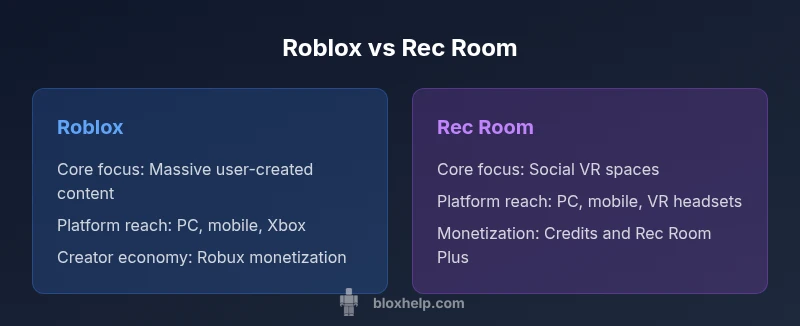
Roblox and Rec Room serve different playstyles: Roblox offers a vast library of user-created games and a robust creator economy, while Rec Room centers on social VR spaces with broad cross‑platform access. For content breadth and creator potential, Roblox wins; for social immersion, headset-friendly play, and real-time interaction, Rec Room shines. This quick comparison helps you decide which platform aligns with your goals as a player or creator.
Roblox vs Rec Room: Framing the Comparison
When evaluating roblox vs rec room, it’s important to frame the context in terms of player goals, hardware availability, and long‑term engagement. Roblox emphasizes a monumental breadth of experiences created by a global community, with a flexible monetization model for creators. Rec Room emphasizes social interaction in a spatial, immersive vibe, using cross‑platform access to connect players whether they have a headset or not. For families and schools exploring accessible social play, both platforms offer distinct advantages, but they cater to different passions: world-building and variety on Roblox, social VR gatherings on Rec Room. As you read, keep in mind your device lineup, budget, and comfort with in‑game creation tools. The central question remains: do you want a creator‑driven engine with endless genres, or a social hub where friends meet in shared rooms?
According to Blox Help analysis, 2026 guidance emphasizes assessing your goals across content scale, community safety, and platform flexibility. The roblox vs rec room decision often hinges on whether you prioritize a massive content atlas or a vibrant social ecosystem that works on multiple devices. The following sections dissect core differences without bias, so you can pick the path that fits your play style.
Comparison
| Feature | Roblox | Rec Room |
|---|---|---|
| Core Focus | Massive library of user‑generated games and experiences across genres | Social VR experiences with shared spaces and live events |
| Platform Availability | PC, mobile, and Xbox with broad reach | PC, VR headsets (Quest/PCVR), and mobile with strong headset support |
| Monetization & Economy | Robux currency, creator revenue programs, in‑game purchases | Credits, in‑app purchases, plus Rec Room Plus subscription |
| Content Library Size | Extremely large and continually expanding | Smaller, but highly curated social experiences |
| Content Creation Tools | Roblox Studio with scripting (Lua) and deployment | Built‑in builder and room editor with instant sharing |
| Social Features | In‑game chat, communities, events, and creator communities | Integrated voice chat, parties, and social spaces with social moderation |
| VR/MR Support | VR support exists but not the core focus | VR‑native experiences with broad headset support |
| Learning Curve | Moderate to steep for core game development | Lower barrier for joining and shaping spaces |
Benefits
- Showcases clear decision criteria for players and creators
- Highlights where scale vs. social immersion shines
- Encourages mindful evaluation of monetization, safety, and accessibility
- Helps set realistic expectations for both platforms
What's Bad
- May oversimplify nuanced genre differences
- Trade-offs vary by user segment and game type
- Does not capture every edge case or third‑party tooling
Roblox is best for content variety and creator opportunity; Rec Room excels at social VR and headset-ready play
Choose Roblox if you want vast content variety and robust creator tools. Choose Rec Room if your priority is social interaction in VR, cross‑platform access, and a more immediate, shared social experience.
Questions & Answers
Which platform is easier for beginners to get into, Roblox or Rec Room?
Rec Room generally offers quicker onboarding for casual social play, while Roblox requires more time to learn building tools if you want to create experiences. Both have active communities and tutorials that help new users ramp up.
If you’re new to online spaces, start with Rec Room for quick social play, then explore Roblox if you want to build your own games.
Does Roblox have a larger content library than Rec Room?
Yes, Roblox’s catalog of experiences is larger and more varied due to its long‑running creator ecosystem. Rec Room’s library is strong for social rooms and event spaces but not as vast in game genres.
Roblox leads in content variety, but Rec Room shines for social rooms and live events.
Is Rec Room VR-exclusive or can I play without VR?
Rec Room supports VR headsets and traditional controls, so you can enjoy most experiences without a headset. VR enhances immersion, but you’re not required to use one.
You don’t need a VR headset to enjoy Rec Room, but VR can boost the feel of being inside the space.
Can creators monetize on Roblox?
Yes. Roblox offers Robux, a creator marketplace, and revenue opportunities through your games and in‑app purchases. The ecosystem is designed to reward popular experiences.
Yes, Roblox has a creator economy with ways to earn from your games.
Which platform is better for social experiences with friends?
Rec Room is tailored for social experiences and live events, making it the stronger choice for group play and shared spaces. Roblox emphasizes individual experiences but also hosts community events.
If your main goal is hanging out with friends in a social space, Rec Room is the stronger pick.
Do both platforms support cross‑platform play?
Yes. Roblox supports cross‑platform play across PC, mobile, and consoles, while Rec Room emphasizes cross‑platform access across PC, mobile, and VR headsets, with some VR-specific features.
Both let you play with friends across devices, though the experience differs by platform.
The Essentials
- Assess your goals: content breadth vs social VR
- Test on your main devices to gauge performance
- Consider monetization expectations and creator tools
- Factor VR availability into your decision
- Review safety and moderation policies before committing
- Both platforms reward active participation and community engagement